About Polygonia comma (Harris, 1852)
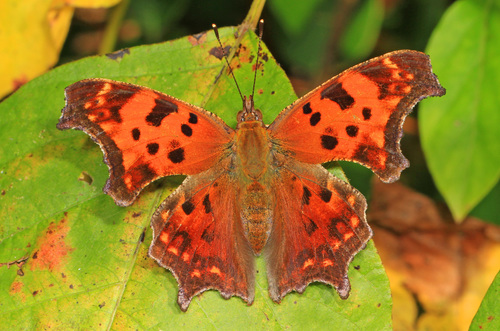
This butterfly species, Polygonia comma, also known as the eastern comma, shows seasonal variation in appearance. For the summer form, the entire upperside of the hindwings is black, while the winter form has reddish orange uppersides to its hindwings. In both forms, the underside of the wings is striped with dark and light brown, and a silvery comma-shaped mark sits in the center of the hindwing. The species has a wingspan ranging from 4.5 cm to 6.4 cm, which is 1.8 to 2.5 inches. Eastern comma butterflies can be found in wooded areas located near rivers, ponds, marshes, swamps, and other bodies of water. Green eggs of this species are laid either singly or in small stacks on the undersides of host plant leaves and on host plant stems. Spiny larvae can range in color from pale green to yellow, white, and even black. Larvae are solitary, and they feed on leaves during the night. Older larvae build daytime leaf shelters by pulling a single leaf closed with silk. The species' chrysalis is brown and covered in spines. Adult winter forms overwinter, and some of these adults will also migrate south to pass the winter.