About Polygonia c-album (Linnaeus, 1758)
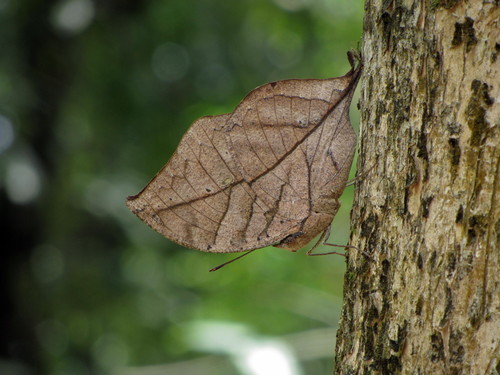
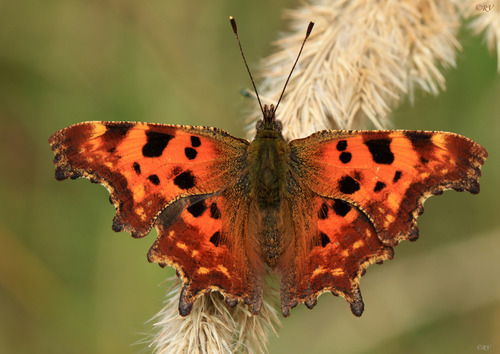
Description: The outer margins of this butterfly's wings are strongly and irregularly toothed, hollowed out, and angled. The upper surface of the wings is bright orange, marked with brown patterns and light spots along the edge. The underside of the wings is marbled with brown. When its wings are folded, the butterfly resembles a dead leaf. On the underside of the hindwings, there is a white spot that usually forms the shape of a comma. Sexual dimorphism in this species is slight, and affects only the intensity of coloration, body shape, and size. Males have a wingspan of 22 to 24 mm, while females have a wingspan of 25 to 26 mm. Seasonal dimorphism is much more distinct. The first generation, the hutchinsoni form named for Emma Hutchinson and active May to June, has fawn orange upper wing surfaces and brown-gold lower wing surfaces. The hindwing has a broad dark red-brown area on its distal end, which contains a row of light brown spear-shaped spots. The underside of the wings is dark, and is either solid colored or heavily marbled. The second generation, the c-album form, active in July, autumn, and spring after overwintering, has a redder upper wing surface and dark brown lower wing surface, with a less bright base color. In the summer form, wings are less toothed. The hindwing has a narrow dark submarginal band; close to this band there is a row of light crescent-shaped marks, bordered on the proximal side by a band of brown arcs. The underside of the wings is paler, with less distinct marbling and shading, though marbling can sometimes be very prominent. Geographic range and habitat: The comma butterfly lives across Europe, North Africa, and Asia. It is primarily a woodland butterfly, found mainly in open, low-density forests with sunlight and moist soil. It is commonly found in woodlands, country lanes, and garden areas of Norway, Sweden, and Great Britain. This species is a food generalist, or polyphagous, meaning comma butterflies can feed on a wide variety of host plants, which has allowed them to develop large, widespread ranges across continents. In response to climate change, this species is currently expanding its range.