About Polygonatum biflorum (Walter) Elliott
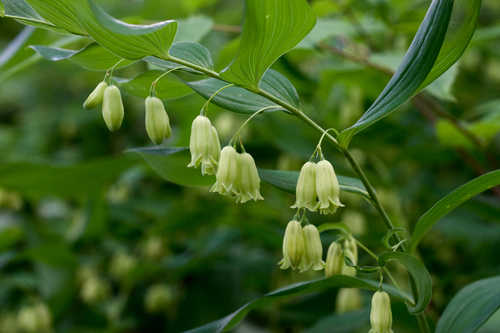
This species, commonly called Solomon's seal, has arching, unbranched leaf stalks that are typically 90 centimetres (3.0 ft) long, but can grow as long as 1.8 metres (5.9 ft). Its leaves are simple, alternate, and marked by prominent parallel veins. From March to June, clusters of small white-green flowers droop from the stalks; after flowering, the plant produces small blue berries. If the rhizome is dug up, scars that resemble a Solomon's seal can be seen on the nodes between the rhizome sections. Solomon's seal grows in rich or rocky woods, and along streambanks. It grows best in full to partial shade, and in medium to wet soil with high humus content, though it can adapt well to a range of other growing conditions. Historically, Native Americans ate the starch-rich rhizomes of smooth Solomon's-seal as a potato-like food, using it to make breads and soups. The plant's young shoots are also edible, eaten raw or boiled as an asparagus-like vegetable. Smooth Solomon's-seal has also been used in herbal medicine: the rhizome was made into a tonic to treat gout and rheumatism, and the species has been used for nearly a dozen different herbal purposes, including as an anti-inflammatory, a sedative, and a tonic. It is not cultivated for large-scale agriculture.