About Polygaloides paucifolia (Willd.) J.R.Abbott
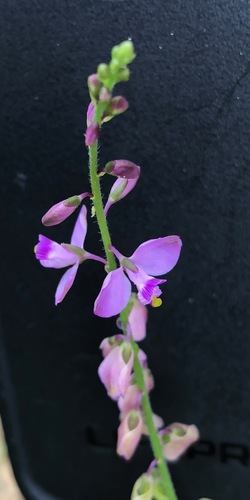
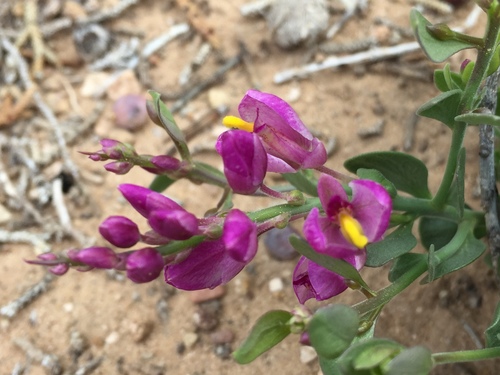
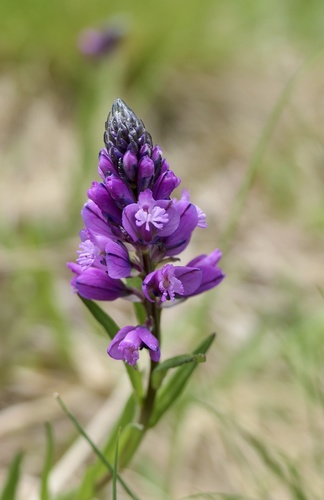
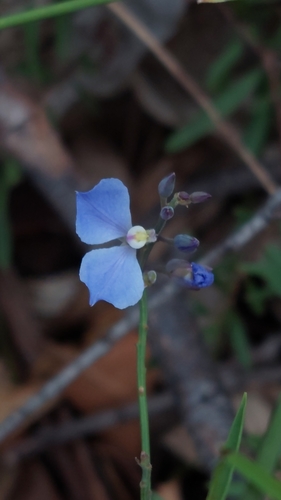
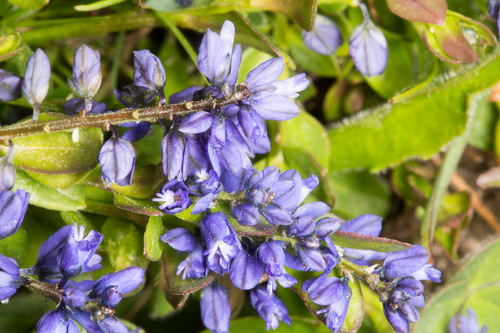
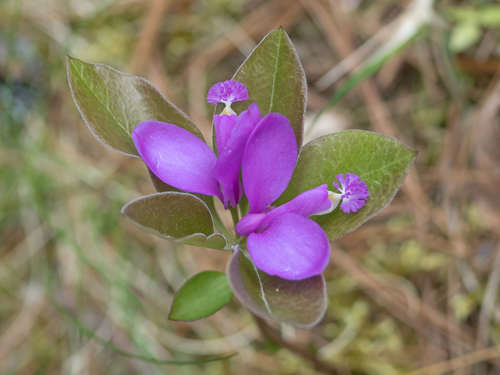
Polygaloides paucifolia (Willd.) J.R.Abbott is a perennial plant often mistaken for an orchid. Mature plants grow 3 to 6 inches tall, with smooth, slender green stems. Leaves are clustered near the top of the stem, appearing whorled, though they are arranged alternately lower on the stem. Leaf blades are oblong to lanceolate, narrow at the base with a pointed tip, have entire margins, and are thin; their surfaces have fine small teeth and are hairless. This species is famed for its small fringed flowers that are said to look like "birds in flight", which has earned it the common nickname gaywing. It typically produces 1 to 4 deep pink chasmogamous flowers with white parts. Two of its sepals resemble petals, flare out like wings, and two of these sepals fuse to form a tube that conceals the plant's reproductive structures; the plant also has three smaller sepals. It has six stamens. Fruits are obovoid capsule-like structures measuring ¼ to 1/3 inch long. It grows from underground stems and spreads laterally via very thin rhizomes. It is native to temperate regions of North America, and has not been found naturally on any other continent. It grows in rich moist woods, dry very rich woodlands (where it reaches its greatest abundance), meadows, forests, woodlands, and field edges. There are 60 tracked populations of this species in the United States alone. Ecologically, this plant relies primarily on ants for seed dispersal, a strategy called myrmecochory. Seeds have a nutrient-rich attachment that attracts ants, which pull seeds into their nests, moving them to new locations underground. However, seeds are particularly rich in lipids, proteins, and starches, so ants will often consume seeds left ungerminated for too long. For cultivation, this species grows best with 60 percent humidity, around six hours of indirect bright sunlight per day, in wet loamy soil. A 5:10:5 soil nutrient ratio is favored for optimal growth, with an average temperature of 18 degrees Celsius. It is recommended to plant seeds directly in the ground rather than transplanting young seedlings, and propagation is ideally done in spring. It grows best under organic farming practices in wet conditions, and does not tolerate commercial farming practices such as pesticide use. Some sources state seeds can be stored for up to four months in dry cold conditions, but more cautious guidance notes seeds have a maximum viability of three months when properly stored. Because it is related to orchids, growing this plant with mycorrhizal fungi in the soil is recommended for best growth and flowering. Eating this plant is purported to increase lactation in most mammals, including potentially humans, but the plant is toxic when consumed orally by humans and most other mammals, and cannot be eaten. It is also toxic to dogs and most animals when flowers are consumed, so contact is not recommended for pregnant people. Historically, it has only been used medicinally as an ingredient in topical ointment preparations. Historically, the plant was used in medicinal practices to treat skin irritation and respiratory illnesses including cough, excess phlegm, asthma, and pneumonia. Native Americans, specifically the Iroquois as documented in the Native American Ethnobotany database by James William Herrick in 1977, also used it for respiratory issues and linked it to cardiovascular health. Documented Iroquois uses include: a decoction of the plant used as a wash for boils and syphilitic sores; an infusion of the plant taken internally and a poultice of leaves applied to abscesses on the limbs; a compound poultice of the plant applied to sore legs; a decoction of the plant used as a wash for babies with syphilitic sores, which also counts as a venereal disease treatment. When consumed or used in high doses, the plant can cause excessive diarrhea and vomiting. Historically, before modern legal abortion and birth control, it was used as a home abortion remedy and thought to prevent conception, but there is no scientific research to support this claim. This species should not be used as a primary treatment, due to its adverse effects when used in high doses.