About Polygala vulgaris L.
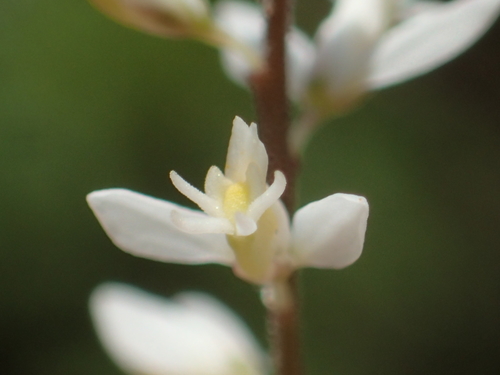
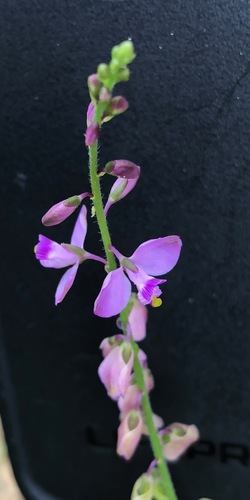
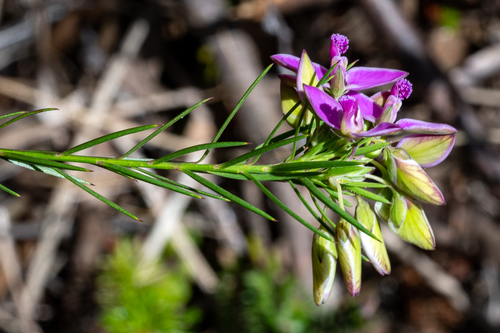
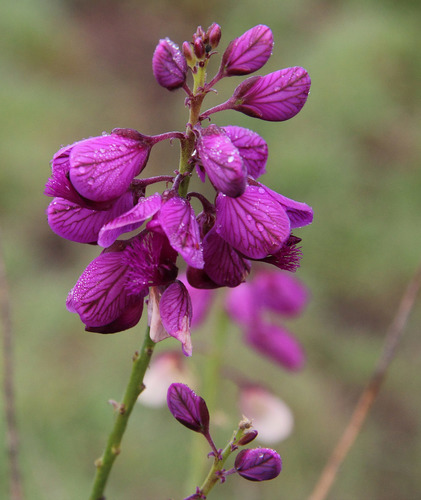
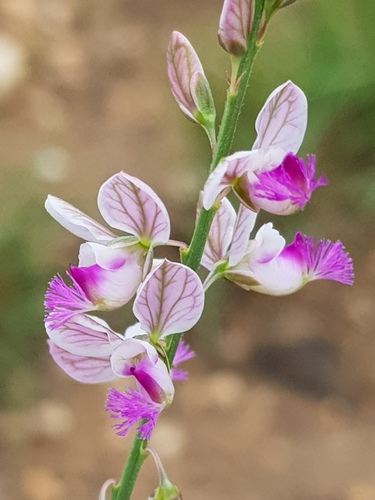
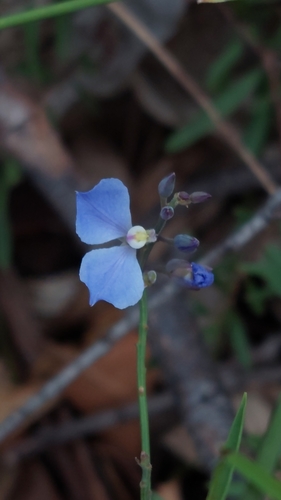
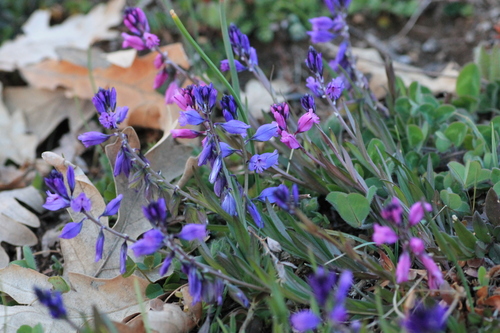
The biological form of Polygala vulgaris (common milkwort) is hemicryptophyte scapose: its overwintering buds sit just below the soil surface, and its floral axis is more or less erect with a small number of leaves. This plant reaches an average height of 7–35 centimetres (2.8–13.8 in). Its stems branch heavily and are woody at the base. It produces alternating, pointed leaves that are nearly hairless, measuring 2 to 4 mm wide and 10 to 20 mm long. Basal leaves are spatulate with a rounded apex, while upper leaves are lanceolate. The flowers are arranged in long terminal inflorescences. Corolla color ranges from blue to violet, and purple forms occur rarely. The outer three sepals of the flower are typically small, green, and unremarkable, while the inner two sepals are larger. The inner sepals are usually shorter than the petals. The stalks of the eight stamens are fused into a tube; two tiny petals are attached to this tube, one on each side. The third petal sits on the lower side of the flower, is also joined to the stamen tube, and is larger with a fringed edge. Its flowering period runs from May to July. Common milkwort is very similar to heath milkwort (Polygala serpyllifolia), but heath milkwort usually has inner sepals longer than the petals. Heath milkwort can have all the same flower colors as common milkwort except white. These four possible color forms give milkworts their Irish folk name 'four sisters'. This species is native to Europe, including European Russia, and Turkey. It has been introduced to Oregon and Michigan in the United States. Common milkwort grows in meadows, slopes, forest edges, heaths, open sunny woods, dunes, and grasslands. It forms frequent patches on calcareous grassland, and occurs from sea level up to 2200 meters. According to Classical and Renaissance writers, common milkwort was used medicinally as an infusion to increase milk flow in nursing mothers.