About Pollichia campestris Aiton
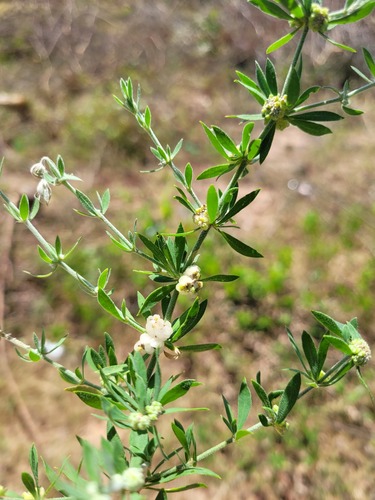
Pollichia campestris Aiton is a much-branched subshrub that grows to around 60 cm (24 in) in height. Its erect stems are covered in fine hairs when young. The leaves are greyish-green, hairy when new, and grow up to 3 cm long by 1 cm wide. They are narrowly lanceolate or elliptical, with pointed apexes, short stalks, and small membranous stipules.
The inflorescence is a small, hairy cyme that grows from a leaf axil. The flowers are greenish-yellow and have white bracts. The fruit is a capsule that retains a persistent receptacle and calyx; the bracts around the fruit become swollen, fleshy, and range in color from waxy-white to dull orange.
Pollichia campestris is native to the Arabian Peninsula, eastern Africa, and southern Africa. Its range extends from Saudi Arabia and Yemen, through Eritrea, south through East Africa as far as Angola, Namibia, Zimbabwe, and South Africa. Its typical habitat includes grasslands, thickets, and open woodland growing on light, sandy soils, at elevations up to 2,340 m (7,700 ft).
This species is a common plant across most of its range in Africa. It often forms part of the subcanopy in the Kalahari thornveld region of South Africa, but in Botswana it typically grows in more open habitats. Its fruits are attractive to birds, which disperse the plant's seeds. Humans also eat the fruits, wild animals browse the plant's foliage, and the species is used in traditional medicine to treat rheumatism and chest problems.