About Polistes metricus Say, 1831
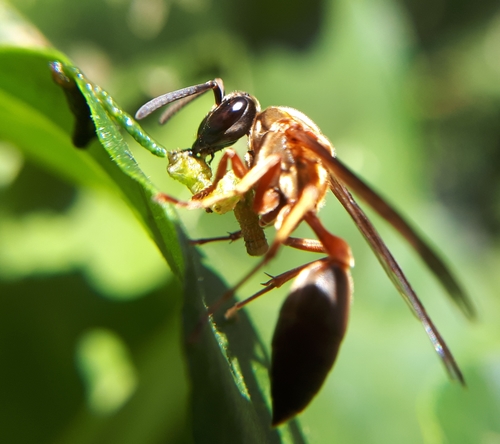
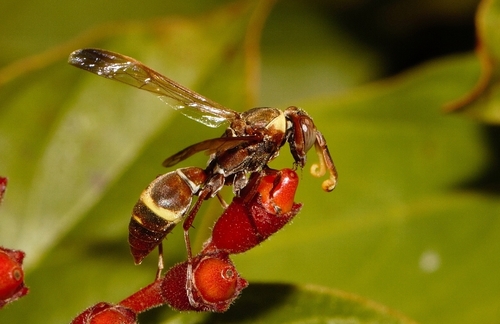
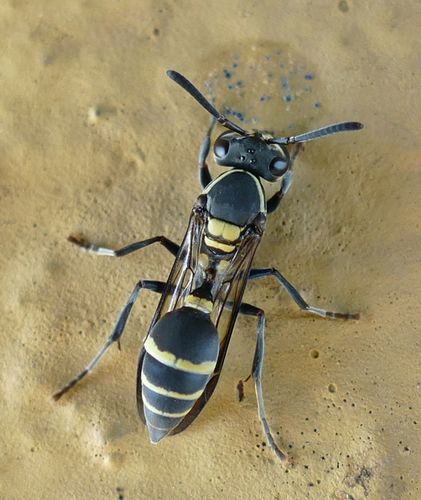
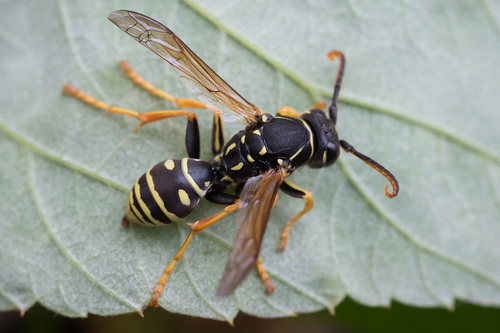
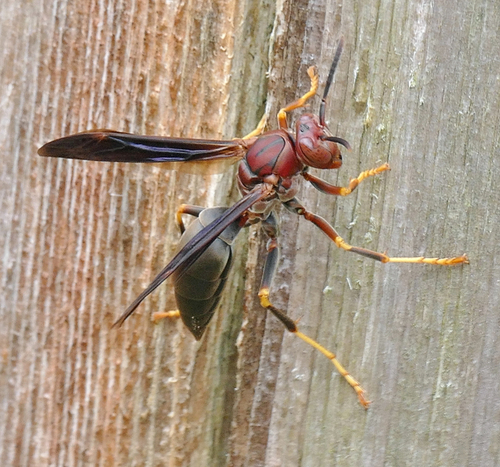
Polistes metricus Say, 1831 is most often dark rusty (ferruginous) in base color, with black markings on the thorax and a mostly black abdomen. Its tibia is black, and the tarsi are yellow. The three ocelli are located within a separate black spot that is not connected to the antennae. Females of this species have six abdominal segments, while males have seven. Swollen regions of the abdomen are a key identifying feature of the species. Females have extensive rust-red coloration on the head and mesosoma, with very limited yellow markings. The mesosoma has a large area of red color, and the metasoma is mostly black. This species also has a distinctly noticeable outward bend in the second sternum, though this characteristic is often very subtle. Males have less red-colored area and more black-colored area than females, have more yellow markings than females, and have entirely yellow faces and yellow pronotal carinae. The extent of yellow coloration on male legs is highly variable between individuals. The smallest larvae can be distinguished from eggs by their darker anterior end. In P. metricus nests, capped cells most commonly contain pupae. When adult wasps emerge from their cocoons, they leave cocoon shavings behind as evidence of metamorphosis. The distribution of P. metricus is mostly restricted to North America. It has been recorded in far southwestern Ontario, Canada. In the eastern United States, one female was observed in Dryden, Maine and recorded by the Canadian Nursery Certification Institute for pest control; this was a new, previously unrecorded sighting for Maine, and is thought to indicate the start of the species expanding its range into Maine. Other confirmed locations for P. metricus in the United States span the east coast, including New York, Pennsylvania, the area from southern Michigan south all the way to Florida, and range westward to Nebraska, Kansas, Oklahoma, and eastern Texas. P. metricus has specifically been studied alongside other wasp species including Polistes bellicosus in Brazos Bend State Park, Texas.