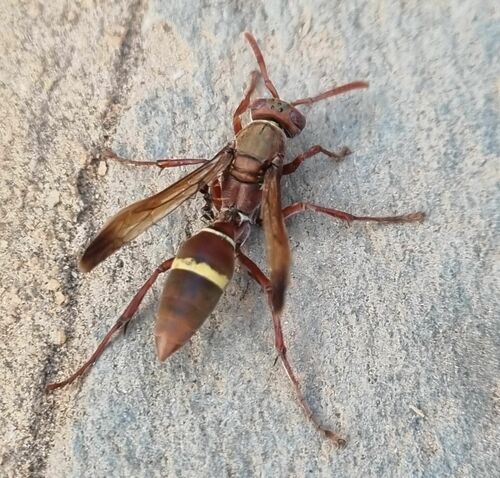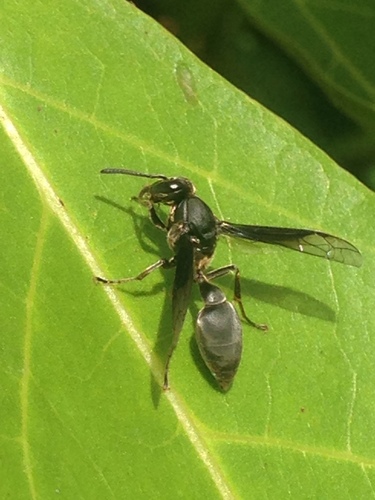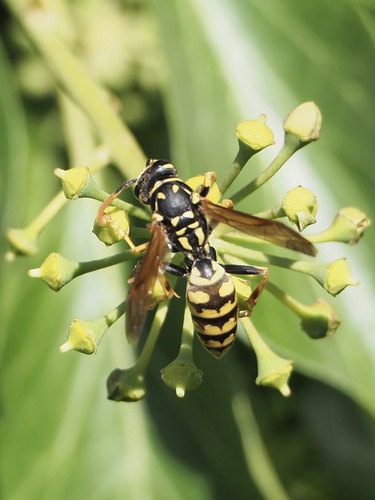
About Polistes gallicus (Linnaeus, 1767)
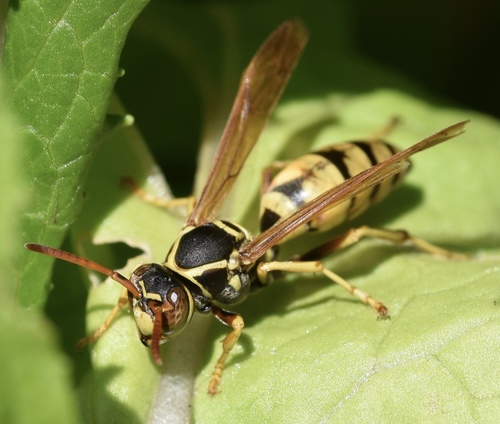
Like other members of the subgenus Polistes (Polistes), Polistes gallicus has recognizable bright yellow and black markings. It has a smaller body than many related species that share its range, and its body is largely hairless. The species can be distinguished from close relatives by the following traits. Females have 12 antennal segments and 6 abdominal segments. Their antennae are orange, paler on the ventral surface than in most allies, and have yellow-marked scapes. The malar space is short, measuring less than 0.75 times the distance between the lateral ocelli, and is black. Females have slender mandibles that are mostly black, with an eccentric yellow spot on each mandible. In contrast, the clypeus is yellow, and often has a small but distinct black spot or band. As with many species in the subgenus, the mesoscutum has a pair of well-developed spots. Both the spots on the propodeum and the continuous band on the fourth abdominal sternite are wide. Unlike species such as P. dominula, P. gallicus has a mostly black hypopygium. Males have 13 antennal segments and 7 abdominal segments. When viewed from the front, the male head is roughly triangular, with a curved clypeus. The apical half of the male antennae is entirely orange-yellow, and the final antennal segment is slightly less than twice as long as it is wide. The pronotum has a yellow band that widens toward the sides, along with short, straight hairs. The mesosternum is largely yellow, more so than in some related species. Both the mesoscutum and scutellum typically have distinct spots. The final abdominal sternite of males is entirely black. The range of P. gallicus covers most of Europe, where it is a common species. Its distribution extends from northern Italy and southern Switzerland south into northwest Africa, and east to Croatia and Corfu. Throughout this range, the species lives in a variety of climates and habitats, but it nests more frequently in warm and dry regions. In these areas, its nests are built hanging in the open, with the nest cells facing toward the ground. In cooler regions north of the Alps, its nests are often built in more protective, enclosed spaces such as pipes or metal scraps. P. gallicus was first sighted in North America in Cambridge, Massachusetts in 1980, and has remained an established species in Massachusetts ever since. It has also been reported to occur in Chile.