About Polistes erythrocephalus Latreille, 1813
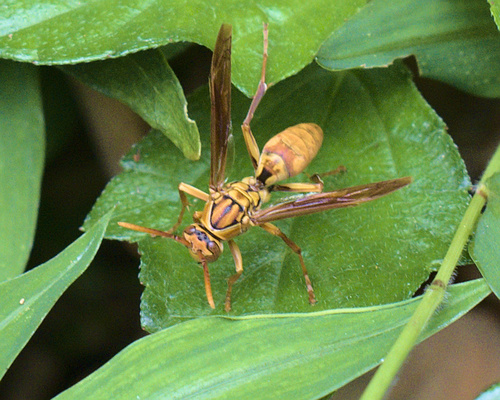
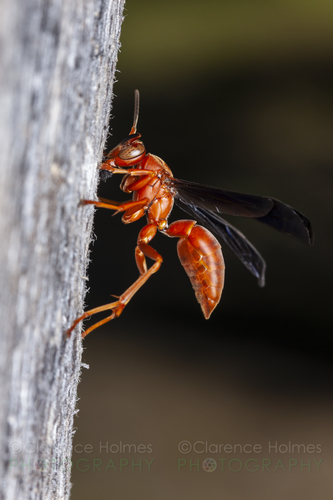
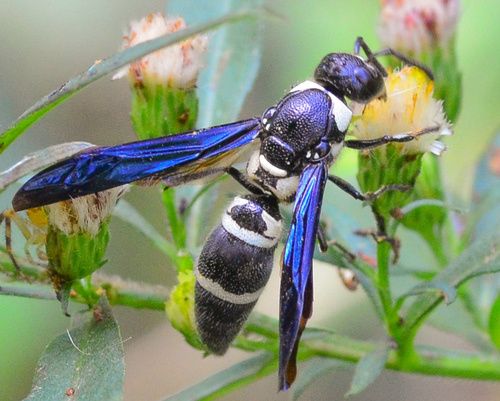
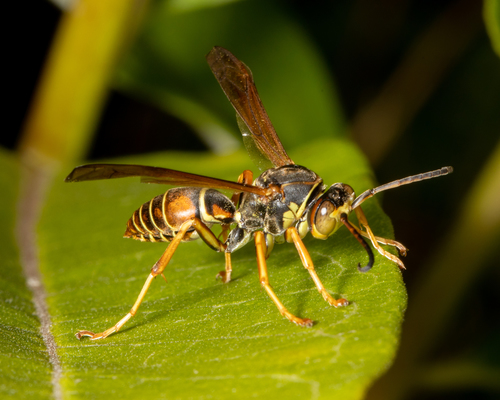
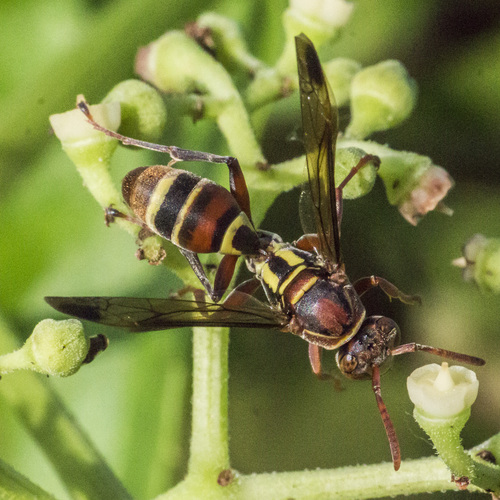
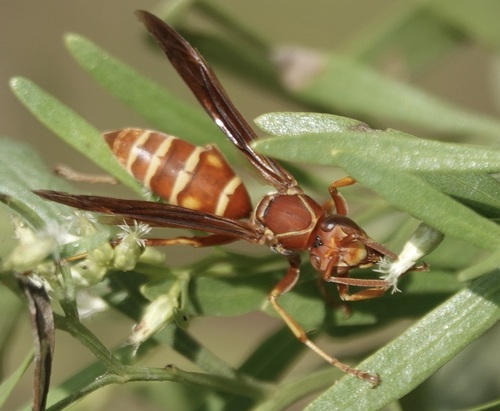
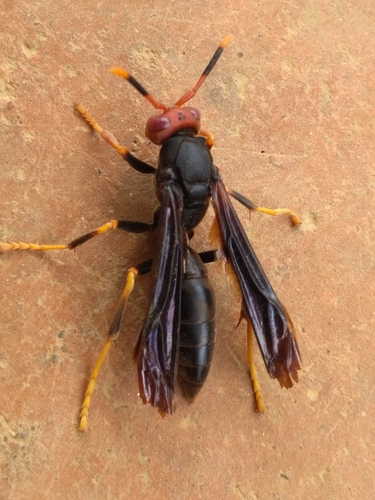
Polistes erythrocephalus Latreille, 1813, is around 21 millimetres (0.83 in) long. It is identified by its black thorax and abdomen, and its body is typically narrower than the bodies of its close relatives like Polistes annularis. Its thorax has no markings, and its abdomen is slightly shinier than the rest of its body. This solid black body contrasts with its head, which is a dull ferruginous, or rust, color. The antennae on the top of its head are also ferruginous, and grow paler toward their tips. The wings of P. erythrocephalus are dark bluish in color, with a distinct glossy sheen. Its legs are black, with yellowish coloring at the tarsi and knee joints. For a long time, P. erythrocephalus was classified as a subspecies of P. canadensis, so the two species were often confused. P. canadensis differs by having ferruginous coloration on its thorax, abdomen, and head, and its wings are usually much lighter in color than its body. This species is distributed across Central and South America. While its populations are most concentrated in Costa Rica and Panama, it has also been recorded in Nicaragua, Venezuela, Colombia, Ecuador, Peru, Bolivia, and Southern Brazil. In Costa Rica, its nests are especially concentrated in Finca Taboga and on the Osa Peninsula. Across its range, P. erythrocephalus builds nests in protected but open areas, found both near human settlements and in undisturbed wild habitats. The average life cycle of P. erythrocephalus is 110 days, with an observed range from 91 to 131 days. Like all Polistes species, it progresses through four maturation phases: egg, larva, pupa, and adult. On average, the egg stage lasts 14 days, the larva stage lasts 29 days, and the pupa stage lasts around 22 days. The adult stage continues until the individual dies, which occurs at an average of 45 days after maturation.