About Polistes apachus de Saussure, 1857
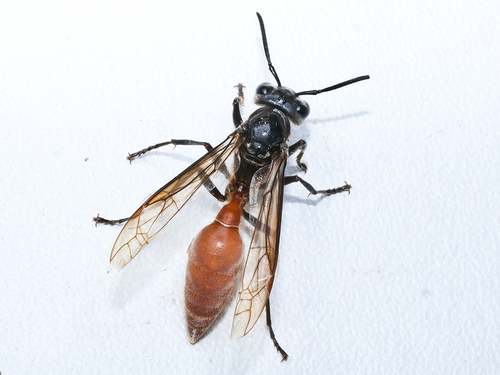
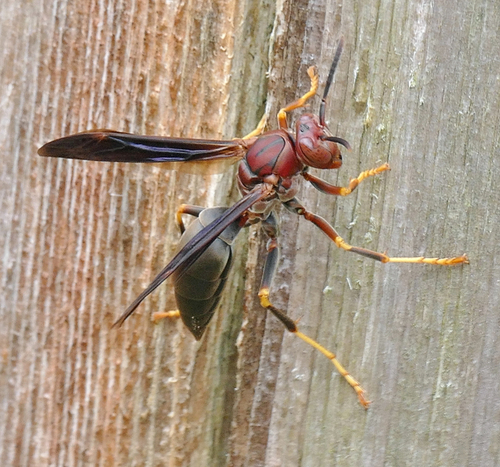
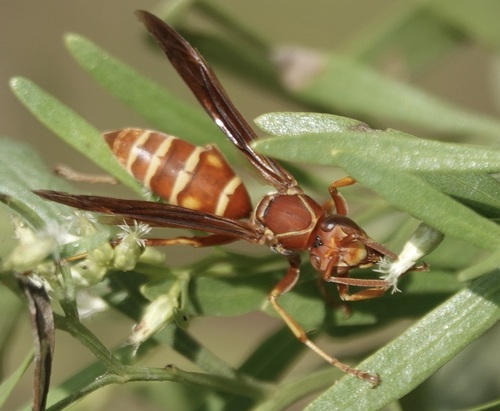
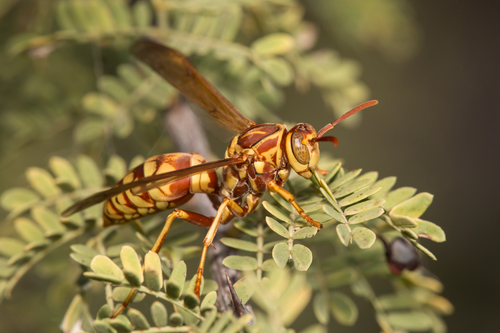
Polistes apachus can reach a maximum body length of around 20 mm, with a golden brown base body color. Like most or all species in the Polistes genus, there is no clear distinguishable difference in size or physical appearance between egg-laying queens and their worker offspring.
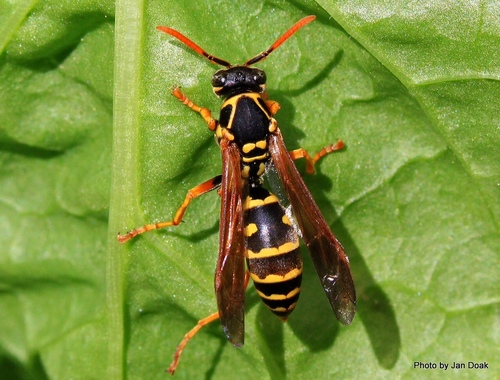
For morphological characteristics, the antennae are all a uniform dull orange-brown. When viewed from the side, the clypeus is almost completely flat. On the thorax, the pronotum has a thin yellow border, while the metanotum has two transverse yellow stripes: the anterior (front) stripe is narrow, and the posterior (back) stripe is broader. The mesoscutum has two longitudinal yellow stripes, although some males lack these stripes entirely; this absence is particularly common in populations of the species found in Texas.
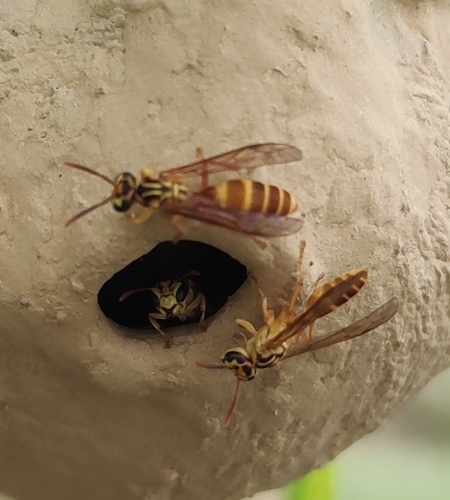
The abdomen has alternating stripes of golden brown and yellow. On the second tergite (a dorsal exoskeleton segment of the metasoma), there are two prominent yellow patches positioned opposite each other slightly sub-laterally (to the sides of the midline). Smaller, less noticeable yellow spots are usually present on the first, third, and all subsequent abdominal tergites. On males, the metasoma has a small rounded projection (tubercle) in the center of the seventh sternite.
This species was first collected in 1856 by Swiss wasp specialist Henri de Saussure, who traveled north from central Mexico into Nuevo México, a large territory that at the time spanned from modern Nevada to Texas, and which had been occupied and annexed by the United States a few years earlier. Polistes apachus is currently distributed across the United States and Mexico. Bohart and Bechtel originally considered the Californian population to be geographically disjunct from the rest of the species' range in eastern Mexico and other parts of the United States, but the species has since been collected in continuous habitats extending south into Baja California and eastward into Arizona.
In terms of habitat, Polistes apachus commonly builds its nests in vineyards and orchards, and can also be found in urban areas. Evidence suggests the species originally evolved in habitats associated with mesquite and grassland, rather than wooded areas.