About Polia hepatica Clerck, 1759
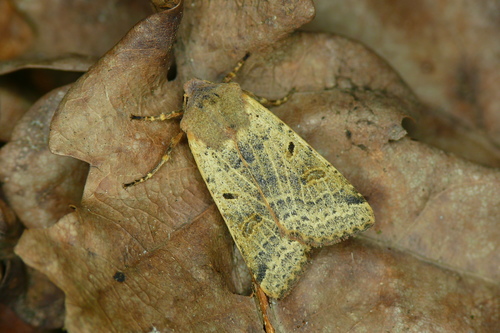
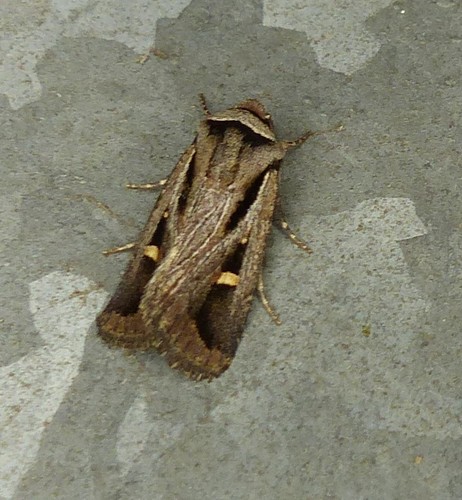
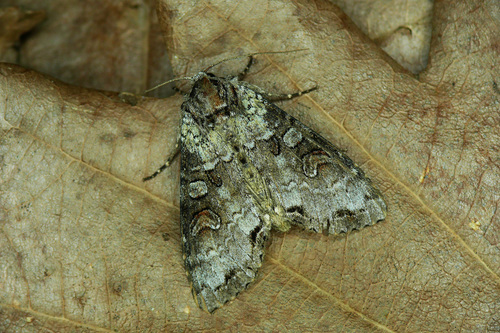
Polia hepatica, commonly called the silvery arches, is a moth species belonging to the Noctuidae family. It was first formally described by Carl Alexander Clerck in 1759. This species occurs across temperate Europe, extending eastward through the Palearctic region to Siberia and Korea. It is not found in the northernmost parts of Fennoscandia, the southern regions of the Iberian Peninsula, Italy, and Greece, and is also absent from Japan. The wingspan of this moth measures 39–47 mm. Its forewings are paler and more bluish grey than those of Polia advena, sometimes taking on a blue-green tone, and have no dark suffusion outside of the median area. The stigmata match those of P. advena, with the orbicular stigma being pale and clearly visible. The submarginal line is preceded by black-brown scales on both folds, does not form wedge-shaped marks, and is not indented on the submedian fold. The hindwing is fuscous, with a dark discal lunule and a pale postmedian line. Several forms of this species have been described: obscurata Stgr. from Amurland is smaller and darker in color; hepatica Hbn. refers to the form with blue-green coloration and brown suffusion; in suffusa Tutt, the median area is distinctly more brown than the rest of the wing. The larva of Polia hepatica is reddish brown with fine dark and light mottling. It has a slender, white dorsal line edged with black, a broader lateral line, and a pale brown head.