About Polemaetus bellicosus (Daudin, 1800)
The martial eagle (Polemaetus bellicosus) is a very large eagle species. Its total body length ranges from 78 to 96 cm (31 to 38 in), with an average of approximately 85.5 cm (33.7 in). Its total length is limited by its relatively short tail compared to its wingspan, and it ranks as the sixth or seventh longest living eagle species. The wingspan of martial eagles ranges from 188 to 240 cm (6 ft 2 in to 7 ft 10 in); wingspans as large as 260 cm (8 ft 6 in) have been reported but may not be substantiated. Claimed average wingspans for the species are 205 cm (6 ft 9 in) and 207.5 cm (6 ft 10 in), but ten wild-measured martial eagles had an average wingspan of 211.9 cm (6 ft 11 in). By average wingspan, the martial eagle ranks fourth among living eagles, behind only the Steller's sea eagle (Haliaeetus pelagicus), the white-tailed eagle (Haliaeetus albicilla), and the wedge-tailed eagle (Aquila audax), in that approximate order. Despite fairly homogeneous genetic makeup, the body mass of martial eagles is surprisingly variable. This variation is partially caused by considerable reverse sexual dimorphism and differing environmental conditions across different populations. Unsexed martial eagles from multiple studies had average weights of 3.93 kg (8.7 lb) across 17 birds, 3.97 kg (8.8 lb) across 20 birds, and 4.23 kg (9.3 lb) across 20 birds, while the average weight of martial eagles shot by game wardens in early 20th century South Africa was recorded as 4.71 kg (10.4 lb). In terms of weight range, the martial eagle broadly overlaps in size with the golden eagle (Aquila chrysaetos) and Verreaux's eagle, and maximum recorded body mass of the martial eagle is even exceeded by these two species. Based on numerous studies, the martial eagle is slightly heavier on average than the Verreaux's eagle, but when combining global body mass data across all golden eagle subspecies, the average body mass of golden and martial eagles is identical at approximately 4.17 kg (9.2 lb). This makes golden and martial eagles tied as the largest African eagles by body mass (the martial eagle is larger than the golden eagle in total length and wingspan), the two heaviest booted eagle species in the world, and tied as the sixth heaviest eagles in the world. The eagles heavier than them are three large sea eagle species (Steller's sea eagle is the heaviest living eagle, with the other two ranking 4th and 5th), the harpy eagle (Harpia harpyja), and the Philippine eagle (Pithecophaga jefferyi). The crowned eagle is the longest African eagle (and the second longest booted eagle after the wedge-tailed eagle) due to its relatively longer tail, as its body weight is slightly lower than the three heaviest booted eagle species.
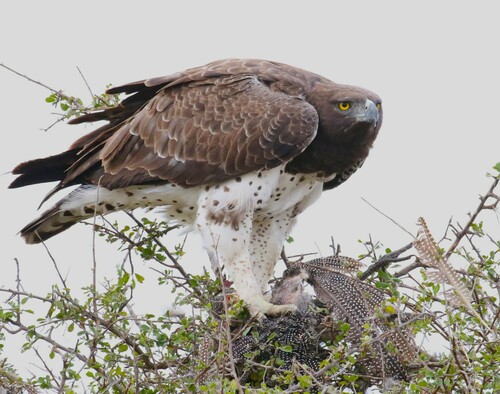
Adult martial eagles have dark brown plumage on the upperparts, head, and upper chest, with occasional slightly lighter edging on these feathers. Depending on lighting conditions, the dark feathers can look grayish, blackish, or even plum-colored. The underparts are feathered white with sparse but conspicuous blackish-brown spotting. Underwing coverts are dark brown, and the remiges are pale with black streaks, giving adult wings an overall dark appearance. The underside of the tail has similar barring to the remiges, while the upperside is the same uniform brown as the back and upperwing coverts. The eyes of mature martial eagles are rich yellow; the cere and large feet are pale greenish, and the talons are black. Martial eagles have a short erectile crest, which is typically neither prominent nor flared (unlike the crowned eagle's crest) and generally forms an angular back to a seemingly flat head. This species often perches in a quite upright position, with its long wings completely covering the tail, leading to the description that it "stands" rather than "sits" on a branch when perched. In flight, martial eagles have long broad wings with relatively narrow rounded tips that can appear pointed at times depending on how the eagle holds its wings. It is capable of flexible flapping followed by gliding with flattish wings, or with wings slightly raised in a dihedral. This species often spends a large portion of the day on the wing, more than probably any other African eagle, and often flies at a great height.
Juvenile martial eagles have distinctly different plumage: pearly gray coloration on the upperparts with extensive white edging, and a speckled gray effect on the crown and hind neck. The entire underside is conspicuously white. Juvenile wing coverts are mottled grey-brown and white, with barring patterns on the primaries and tail that are similar to adults but lighter and greyer. In the fourth or fifth year of life, brownish feather speckling gradually increases, but the back and crown remain fairly pale grey. At this age, spots may increase on the throat and chest, coalescing into a gorget, and some spots may also appear variably on the abdomen. Juvenile eyes are dark brown. This species reaches full adult plumage by its seventh year; after many years with little change in juvenile plumage, the transition to adult plumage happens quite rapidly.
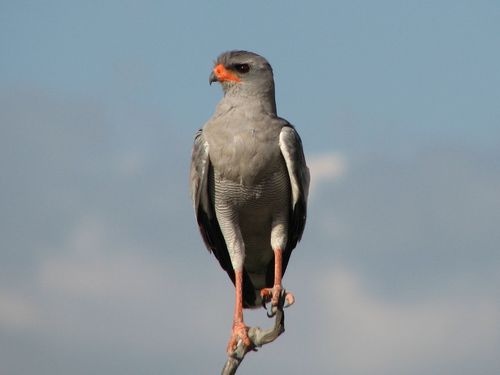
There are a few notable identification challenges for this species. The black-chested snake eagle (Circaetus pectoralis) has similar overall colouring to adult martial eagles (despite its name, it is brown on the chest and back, no darker than an adult martial eagle) but is markedly smaller, has a more prominent, rounded head with large eyes, a plain, spotless abdomen, and bare whitish legs. In flight, the profile of the black-chested snake eagle is quite different, with nearly white flight feathers instead of dark brown, much smaller narrower wings, and a relatively larger tail. For juveniles, the main source of potential confusion is the juvenile crowned eagle, which also often perches in an erect position. The body proportions of crowned eagles are quite distinct from martial eagles, as they have much shorter wings and a distinctly longer tail. The juvenile crowned eagle has a whiter head, more scaled upperparts, and spotted thighs and legs, which are all features that juvenile martial eagles lack. Beyond their distinct flight profile from differing wing and tail proportions, crowned eagles have whiter and more clearly banded flight feathers and tail. Other large immature eagles in Africa tend to be much darker and more heavily marked both above and below than juvenile martial eagles.
The martial eagle occurs across most of sub-Saharan Africa, in areas where food is abundant and environmental conditions are favorable. It has a total estimated distribution area of about 26,000 km² (10,000 sq mi), giving it a substantial range across Africa that is somewhat broader than other large African eagle species such as the crowned eagle (Stephanoaetus coronatus) and the Verreaux's eagle (Aquila verreauxii). While never common, higher population densities are found in southern Africa and some parts of east Africa. Martial eagles are rare and irregularly distributed in west Africa, but are known to live in Senegal, The Gambia, northern Guinea-Bissau, southern Mali, and the northern portions of Ivory Coast and Ghana. From southern Niger and eastern Nigeria, the species is distributed sparsely through Chad, Sudan, the Central African Republic, and the northern, eastern, and southern portions of the Democratic Republic of the Congo. In east Africa, their range extends from Somaliland and Ethiopia more or less continuously south through Kenya, Uganda, and Tanzania. In southern Africa, their range extends from Angola, Zambia, Malawi, and southern Mozambique to South Africa. Some of the largest remaining populations are known to persist in Zimbabwe and South Africa. Generally, these birds are more abundant in protected areas such as Kruger National Park and Kgalagadi Transfrontier Park in South Africa, or Etosha National Park in Namibia.
The martial eagle is somewhat adaptable to varied habitats but overall prefers open woods, woodland edges, wooded savannah, and thornbush habitats. It has been recorded at elevations up to 3,000 m (9,800 ft), but it is not a true mountain dwelling species, and resident eagles do not usually occur at elevations exceeding 1,500 m (4,900 ft). These eagles also avoid closed-canopy forests and hyper-arid desert. As such, it is mostly absent from Guinean and Congolian forests, despite the species requiring large trees for nesting. Martial eagles can inhabit forests locally in areas where clearings occur. For example, in a bird atlas for Kenya, 88% of martial eagles were surprisingly found to reside in well-wooded areas, and they occurred in areas where annual rainfall exceeded 250 mm (9.8 in). In southern Africa, they have adapted to more open habitats than elsewhere in their range, such as semi-desert and open savanna with scattered trees, wooded hillocks, and, as a recent adaptation, areas around pylons. In the desert areas of Namibia, they utilize ephemeral rivers that flow occasionally and allow large trees to grow. They usually seem to prefer desolate or protected areas. In the Karoo of South Africa, they consistently avoid areas with moderate to heavy cultivation or with heavier or more consistent winter rainfall. One study comparing the occurrence of diurnal raptors in protected versus unprotected areas found that martial eagle detection was nearly twice as frequent in protected areas during the dry season, and more than three times as frequent during the wet season, compared to unprotected areas.