About Polanisia erosa (Nutt.) Iltis
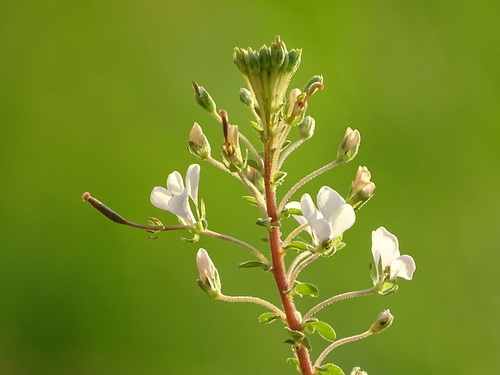
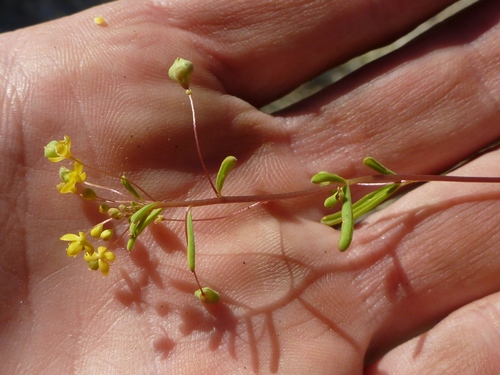
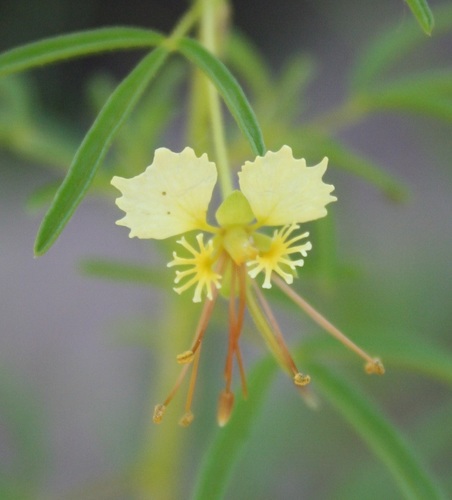
Polanisia erosa, commonly called large clammyweed, is a sticky, unscented annual herb that grows between 10 and 60 cm (3.9 and 23.6 in) tall. Its stems may be branched or unbranched, are green or purple, and bear sessile glands and glandular hairs. Leaf stalks are 0.3–1.5 mm (0.012–0.059 in) long, green or purple, and are often angled relative to the leaf blade. Each leaf blade is made up of three narrow, somewhat fleshy leaflets that are 0.9–3.5 cm (0.35–1.38 in) long and only 1–2 mm (0.039–0.079 in) wide. Each leaflet is conduplicate, with its right and left halves folded more or less toward each other, has entire margins, and ends in a needle-like tip. The underside of each leaflet has many glands, while the upper side has few glands. The bilaterally symmetrical flowers are arranged in gland-covered racemes. These racemes are initially 1–3 cm (0.39–1.18 in) long, and continue growing to reach 6–8 cm (2.4–3.1 in) long when fruits ripen. Each individual flower is subtended by a bract structure of one to three entire oval bractlets, which measure 7–15 mm (0.28–0.59 in) long. The stalk of an individual flower is 1–2.3 cm (0.4–0.9 in) long. The four sepals are deciduous, eventually deflected, hairless, and range in color from green to purple. They are lanceolate to inversely egg-shaped, 2.5–3.5 mm (0.1–0.14 in) long, 0.8–1.3 mm (0.03–0.05 in) wide, and have entire margins and a pointed tip. The four petals are mostly creamy white and oblong-ovate, each with a more yellowish, straight, narrow claw and a wide blade. The forward-facing lower (abaxial) pair of petals is 3–5 mm (0.12–0.20 in) long and 2.5–3 mm (0.10-0.12 in) wide; the upper 0.7 cm of these petals is deeply incised, creating nine or ten finger-like lobes that are often themselves split once or even twice into two lobes, which gives the margin a lacerate appearance. The upper (adaxial) pair of petals is 6–11 mm (0.24–0.43 in) long and 3.5–5 mm (0.12-0.20 in) wide, and is less deeply incised with four to six finger-like lobes. The tube-shaped nectaries are yellow, turn purple when dry, and measure 1-5.5 mm (0.02–0.12 in) long. There are six to fifteen stamens that extend beyond the petals, each consisting of a purple 1–1.3 cm (0.4-0.5 in) filament topped with a purple 1–1.5 mm (0.04–0.06 in) long anther; the anthers do not coil when pollen is released. The 5–8 mm (0.20–0.31 in) long ovary sits at the end of a gynophore that grows to 3–14 mm (0.12–0.55 in) long when the fruit is ripe. A persistent 2.5–4.5 mm (0.10–0.18 in) long style extends from the ovary, ending in a green stigma. The fruit is a capsule 2–6 cm (0.79–2.36 in) long and 0.2–0.5 cm (0.1-0.2 in) in diameter, with a netted surface that may or may not have some glandular hairs. Each capsule holds twelve to forty dark reddish brown seeds, which are globular to ovate, 1.5–1.8 mm (0.06–0.07 in), with a knobbly surface. Large clammyweed is naturally found in Texas and adjacent parts of Arkansas, Louisiana, and Oklahoma. It grows in fields, prairies, sandy hillsides, and open woodland.