About Pogonomyrmex badius (Latreille, 1802)
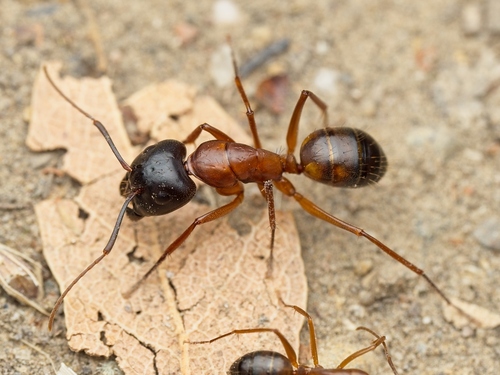
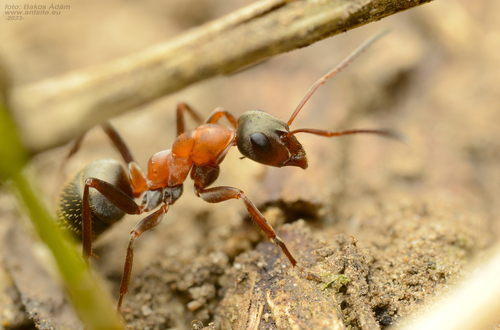
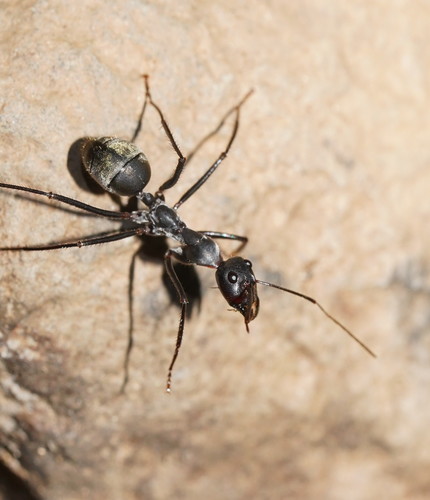
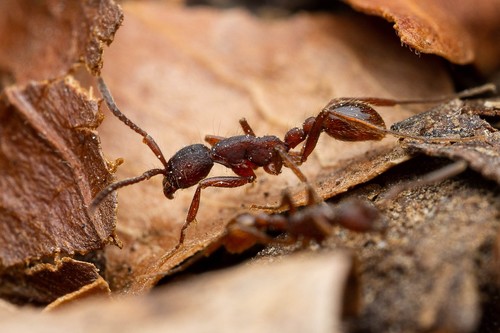
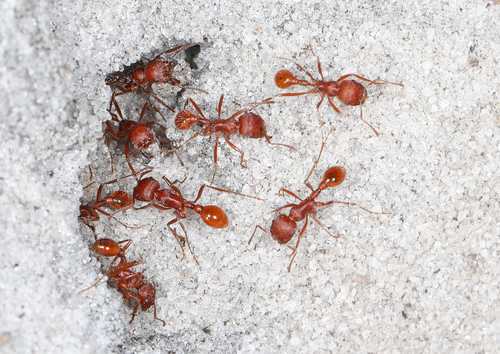
Pogonomyrmex badius is a relatively large species of harvester ant found throughout Florida scrub, and is one of the most notable and unique inhabitants of this ecoregion. Its workers are highly polymorphic: the smallest workers measure 6.35 mm, while the largest major workers reach 9.52 mm, a size that can rival that of the species' queen, which measures 10 to 12 mm. Queens, major workers, and intermediate workers all have disproportionately large heads when viewed from the front, while minor workers have a narrower head shape. Normally, this species does not have epinotal spines that sit parallel on the propodeum, though these spines may occasionally be present. Colonies reach sexual maturity once their worker population reaches a minimum of approximately 700 or more workers, and production of winged reproductives begins around spring. Nuptial flights are most frequently observed from May to June, with late-season flights occurring in July. Flights take place during calm, sunny, humid mornings that follow a day of heavy rain, which leaves the ground moist. Female and male alates do not mate in the air; instead, males fly in from other nests to mate with females on the surface of the females' parent nest. During this time, hundreds of excited workers can be seen acting frantically around the nest disk, and many workers attempt to break apart copulating pairs. Female alates mate with multiple males over subsequent mating flights in the following days. Workers gradually become more intolerant of alates that attempt to re-enter the nest, and eventually alates are either forcibly evicted or denied entrance. Newly mated queens either fly or walk some distance away from their parent nest to establish a new colony. Founding queens may temporarily work together in a process called pleometrosis, but true polygyny has never been observed in wild mature colonies of this species. Queens are fully claustral when founding, so they do not leave the nest to feed, and instead rely solely on their own fat reserves and wing muscles to sustain themselves and their brood. Like most species in the genus Pogonomyrmex, P. badius has a stinger that can deliver a highly potent, painful neurotoxic venom adapted for defense against predatory vertebrates. The venom of this species is considerably toxic, with an LD50 of 0.42 μg/g in mice, which is comparable to the most toxic snake venoms. Despite this high toxicity, the amount of venom yielded per sting is very low, and dozens of stings are required to cause potential harm to a healthy adult. P. badius is also a rather docile ant, and is reluctant to sting unless forced. Stings usually only occur when the ant is trapped against a person's skin in some way. Along with a few other Pogonomyrmex species, P. badius workers exhibit stinger autotomy: the barbed stinger and venom sac is left embedded in the skin to continuously pump venom. This autotomy results in the death of the ant due to internal damage from pulling out the stinger, a process that works the same way as it does in honey bees.