About Pogonocichla stellata (Vieillot, 1818)
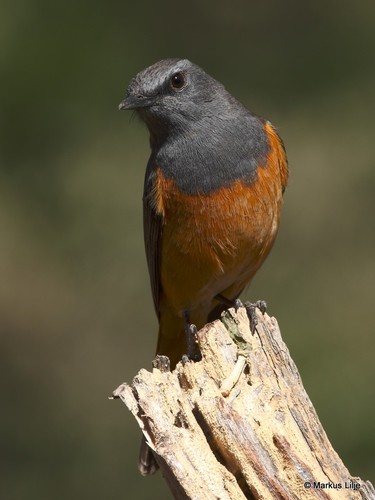
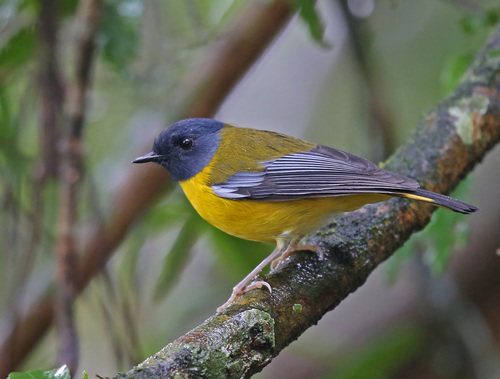
The white-starred robin, Pogonocichla stellata (Vieillot, 1818), is a small robin species that measures 15 to 16 cm (5.9–6.3 in) in length and weighs between 18 and 25 g (0.63–0.88 oz), with females slightly smaller than males. The plumage of the nominate race has slate-grey colouring on the head, with a white spot in front of each eye and an additional small white spot on the throat. The mantle is moss-green, part of the wings is olive-green, the remaining sections of the wings are bluish grey, and the tail is black with yellow lateral stripes. The breast and belly are bright yellow, and the legs are pinkish. The plumage of both sexes is identical. The bill is broad and black, and unlike other robin species, it is surrounded by well-developed rictal bristles that are used for flycatching. Juvenile birds are blackish-brown on their upperparts with golden flecks, and yellow on their underparts with brown scaling. The nominate race has a sub-adult plumage that is dusky olive on the upperparts, with yellow breast and belly marked with grey streaks; the tail matches the adult pattern but is brownish instead of black. This sub-adult plumage is retained for up to two years. Multiple recognized geographic races differ in plumage colouration from the nominate: the race pallidiflava matches the nominate but has paler yellow colouring on the breast and belly; the race intensa is quite distinct, with a bronze-washed back, yellow rump, and slate edges on the flight feathers; the race ruwenzori resembles intensa but has deeper yellow colouring on the breast; the race elgonensis matches the nominate but has an entirely black tail, and the sub-adult of this race has some yellow on the tail; the race macarthuri is paler on the underparts and has a deeper greenish-olive back; the race helleri has a green back and yellow rump; the race orientalis has a green rump, greyish wings, and more greenish colouring on the upper wings; the race hygrica matches the nominate but has a saturated moss-green back; the race transvaalensis resembles hygrica but has more orange-yellow colour on the underparts and a silvery edge to the flight feathers; and finally, the race chirindensis has brighter yellow-green colouring on the back. The white-starred robin is principally found in primary or secondary moist evergreen forest, and requires forest with a well-developed understory of shrubs and vines. It also occupies forest edges, pine and wattle plantations, evergreen woodlands, and forest edge gardens. It is occasionally reported in bamboo or heath zones in some mountains. In the northern parts of its range near the equator, it occurs in mountains between 1,500 and 2,200 m (4,900–7,200 ft) in elevation, and sometimes as high as 3,300 m (10,800 ft). Further south in Zimbabwe, it seldom occurs above 1,300 m (4,300 ft), and in South Africa it can occur at sea level. The white-starred robin is a partial migrant, and its movement is altitudinal: birds move to lower altitudes during the winter, from April to September, and this movement pattern is much more pronounced in the southern parts of the range. In Malawi, birds descend to the shores of Lake Malawi, which sits at 300 m (980 ft), while birds in South Africa and Mozambique move as low as sea level and may travel 120 km (75 mi) from their breeding sites. Studies in Malawi have confirmed that males remain in their breeding territories during the winter, while females move away.