About Poekilocerus pictus (Fabricius, 1775)
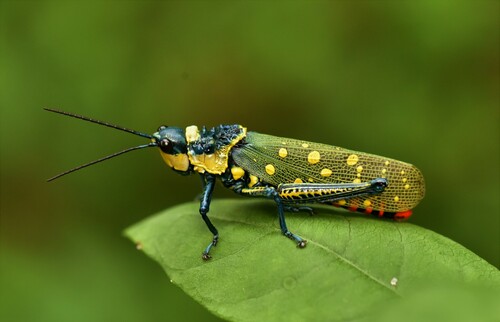
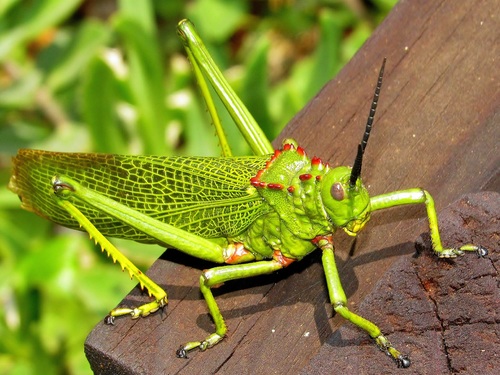
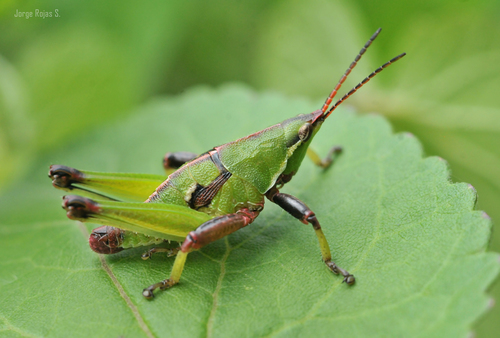
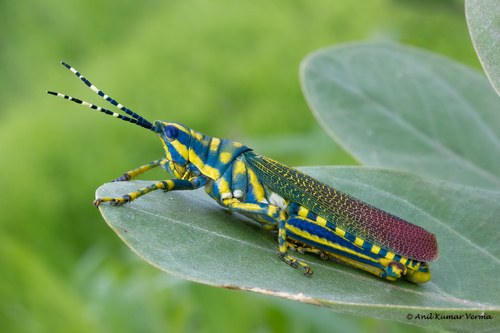
Adults of Poekilocerus pictus are typically 4.3–6.1 cm (1.7–2.4 in) in length. Nymphs are greenish-yellow, marked with fine black patterns and small crimson spots. Mature grasshoppers have canary yellow and turquoise or blue stripes across their body, green forewings (tegmina) with yellow spots, and pale red or orange hind wings. Both adult and nymph P. pictus feed heavily on poisonous Calotropis milkweeds, most commonly Calotropis gigantea and Calotropis procera, and sequester toxins from these plants for their own defense. When given a choice of these two milkweed species, both life stages prefer C. procera over C. gigantea. P. pictus adults and nymphs also feed on a wide variety of other plants, including multiple commercially important agricultural crops. Because of this feeding habit, they are sometimes considered a serious agricultural pest. When nymphs feed primarily on plants other than Calotropis milkweeds, their development proceeds more slowly than when they feed on milkweed. However, even when given a choice, the first two nymphal instars tend to prefer various weeds over Calotropis. The common names aak grasshopper and ak grasshopper come from the local name for P. pictus's main food plants, C. gigantea and C. procera. Cannibalism regularly occurs when P. pictus are starved. If a nymph's head or abdomen is gently pinched, it will eject liquid in a sudden sharp jet that can reach up to approximately 30 cm (1 ft) or more from a dorsal opening between its first and second abdominal segments. The ejection is aimed toward the pinched area, and can be repeated multiple times. The liquid is pale, milky, slightly viscous, and has an unpleasant odor and taste; it contains the cardiac glycosides that the insect acquired from the plants it has fed on. In adult P. pictus, defensive discharge is released under the tegmina and accumulates as a viscous bubbly mass along the sides of the body, and does not produce the squirting effect seen in nymphs.