About Poecilotriccus plumbeiceps (Lafresnaye, 1846)
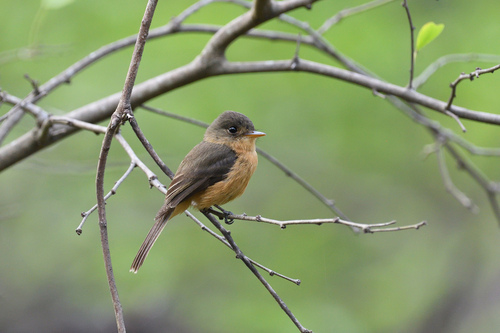
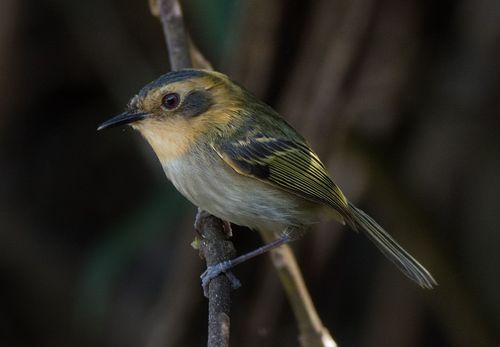
The ochre-faced tody-flycatcher, scientifically named Poecilotriccus plumbeiceps (Lafresnaye, 1846), measures 9 to 10 cm (3.5 to 3.9 in) long and weighs 5.3 to 6 g (0.19 to 0.21 oz). Males and females share identical plumage. Adult individuals of the nominate subspecies P. p. plumbeiceps have a buffish cinnamon forehead and a gray crown. Most of their face is buffish cinnamon, with dusky ear coverts. Their back, rump, and uppertail coverts are dark olive. Their wings are dusky, with ochraceous edges on the flight feathers and ochraceous tips on the coverts; the tipped coverts form two distinct wing bars. Their tail is dark olive. Their throat is a slightly paler shade of buffish cinnamon than their face. Their breast and belly are grayish white. Subspecies P. p. viridiceps has an olive tinge on the crown and a grayer breast than the nominate subspecies. P. p. obscurus is similar in appearance to viridiceps, but is darker across its entire body. P. p. cinereipectus has a grayer breast than the nominate subspecies. All subspecies of this bird have a brown iris, a dark grayish bill, and dark grayish legs and feet.
This species has a disjunct distribution, with each subspecies occupying a separate range. P. p. obscurus is found on the eastern slope of the Andes, from Cuzco Department in southeastern Peru south into Bolivia, reaching as far as Santa Cruz Department. P. p. viridiceps occurs on the eastern slope of the Andes, from Chuquisaca Department in southern Bolivia south into northwestern Argentina, reaching as far as Salta Province. P. p. plumbeiceps lives in eastern Paraguay, the Misiones and Corrientes provinces of northeastern Argentina, southeastern Brazil from Rio de Janeiro and São Paulo states south through Rio Grande do Sul, and extreme northeastern Uruguay. P. p. cinereipectus is native to northeastern and east-central Brazil, ranging from Pernambuco south to southeastern Minas Gerais and Espírito Santo. This species was first documented in Uruguay in 1997, with additional documented observations recorded in 1999 and again in 2006. The ochre-faced tody-flycatcher inhabits humid forest edges and dense undergrowth in secondary forest. It prefers areas that contain dense vine tangles, Chusquea bamboo, Pteridium bracken, and shrubs.