About Poecilotriccus latirostris (Pelzeln, 1868)
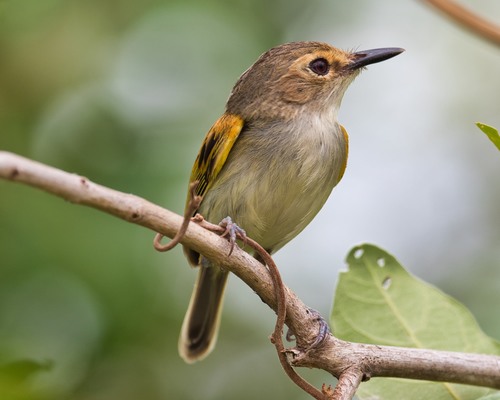
The rusty-fronted tody-flycatcher, scientifically named Poecilotriccus latirostris (Pelzeln, 1868), measures 9 to 9.5 cm (3.5 to 3.7 in) long and weighs approximately 7 to 9 g (0.25 to 0.32 oz). Both sexes share identical plumage. Adults of the nominate subspecies P. l. latirostris have a brownish gray crown. Their forecrown, which is called the 'front', and face are rusty-buff, with the brightest coloring on the lores and around the eyes. Their back, rump, and uppertail coverts are olive. Their wings are dusky, with narrow yellowish edges on the flight feathers and ochraceous tips on the coverts; these ochraceous tips form two distinct wing bars. Their tail is dusky. Their throat and underparts are grayish white, with a faint olive tinge on the breast and flanks. Other subspecies differ from the nominate and each other in the following ways: P. l. caniceps has a darker, browner forehead and darker loral and eye areas than the nominate, with a dark grayish olive crown, a darker green back, darker olive wash on the breast and sides, and a yellow wash on the belly. P. l. mituensis is similar to caniceps but smaller, with a darker grayer crown and darker face and back. P. l. ochropterus has a brownish crown with no gray present, paler and buffier face and paler underparts with less olive than the nominate, and a golden tinge on the back. P. l. mixtus is intermediate between caniceps and ochropterus. P. l. senectus has a brownish crown, duller upperparts than most subspecies, and has the darkest, grayest breast, as well as the whitest throat and belly of all subspecies. P. l. austroriparius is similar to senectus, with darker upperparts and buffy rather than yellowish edges on some flight feathers. All subspecies have an iris that is light reddish brown, pale pink-tan, or dark brown, a black bill, and gray legs and feet. The species' subspecies are distributed across the following regions: P. l. mituensis is found in the area around Mitú, Vaupés Department in southeastern Colombia. P. l. caniceps ranges from the southern Colombian departments of Putumayo, Caquetá, and Amazonas east to central Amazonas state in Brazil, and extends south through eastern Ecuador and most of eastern Peru. P. l. latirostris occurs in western Amazonian Brazil, from the upper Juruá and Purus rivers east to the Parintins area in far eastern Amazonas. P. l. mixtus ranges from northern Puno Department in southeastern Peru south and east into the La Paz, Beni, and Cochabamba departments of Bolivia. P. l. ochropterus is found in southern Brazil, from Mato Grosso and Tocantins south to Mato Grosso do Sul and northwestern São Paulo states. P. l. austroriparius occurs in Brazil, on the right bank of the lower Tapajos River in western Pará. P. l. senectus is found in Brazil north of the Amazon, from northeastern Amazonas east to northwestern Pará. While most other sources do not include Paraguay within this species' range, the South American Classification Committee of the American Ornithological Society has documented records of the species there. The rusty-fronted tody-flycatcher lives in low, dense vegetation along river edges, in secondary forest, and in gallery forest. It is also found in shrubby clearings within forest and on river islands. In terms of elevation, it occurs up to 1,100 m (3,600 ft) in Brazil, 1,200 m (3,900 ft) in Colombia, 700 m (2,300 ft) in Ecuador, and 1,000 m (3,300 ft) in Peru.