About Poecilostreptus cabanisi (P.L.Sclater, 1868)
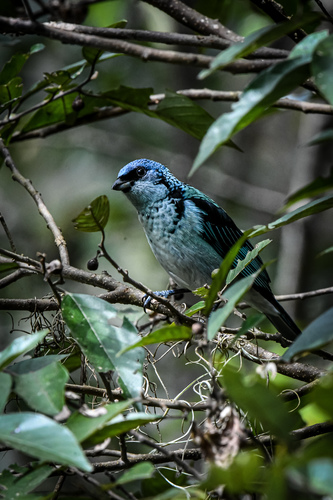
This species, commonly known as the azure-rumped tanager, has mostly pale blue plumage, with a purplish-blue crown, dark lores and lower auriculars, and distinctive dark spots across the chest. Its mantle is mottled greenish-blue and black, while its wings and tail are black with blue edgings. Its bill is gray with a dark tip. Cabanis's tanagers (another common name for this species) produce several types of sibilant vocalizations, including hard trills and twitters. The azure-rumped tanager is omnivorous, and feeds on fruit and arthropods. In Guatemala, the tanager's abundance is positively correlated with the density of Ficus aurea trees; figs from this tree are a main food source for the species. The tanager's nesting season runs from April to September. During the nesting season, azure-rumped tanagers move in pairs or family groups, and cooperative breeding has been reported for the species. Outside of the breeding season, larger flocks of up to 18 individuals have been observed. The azure-rumped tanager is classified as Vulnerable due to deforestation carried out to clear land for coffee plantations. In Guatemala, only 21% (equal to 25,000 hectares or 62,000 acres) of the species' potential distribution area remains covered in broadleaf forest, which is the tanager's primary habitat. 68% (equal to 80,000 hectares) of the potential distribution area is now covered by coffee plantations. It is estimated that between 8,250 and 23,250 azure-rumped tanagers remain in Guatemala. There is no recent population estimate for the population in Chiapas; in the 1980s, there were 112,000 hectares of suitable habitat in the region, but this area is expected to be much smaller now, due to a growing human population and increased pressure from agricultural activities. The species' closest relative appears to be the similarly patterned grey-and-gold tanager.