About Poecilia velifera (Regan, 1914)
Species Nomenclature
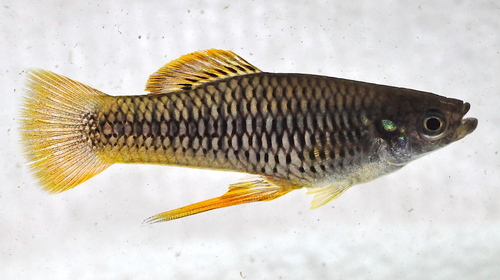
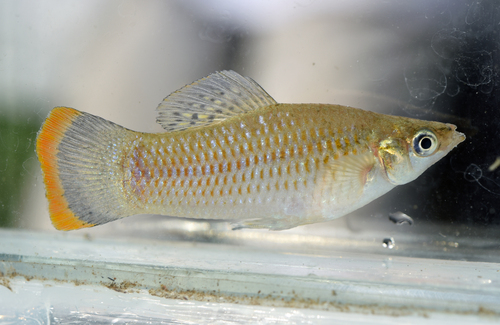
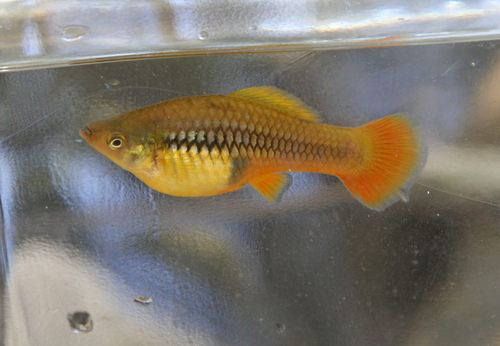
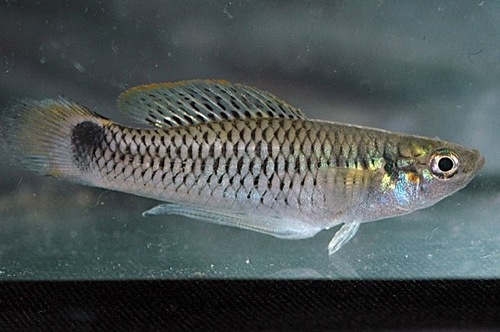
Poecilia velifera (Regan, 1914), commonly called the Yucatán molly, reaches a maximum total length of 15 cm. It has a distinctly deep body and a relatively large head, with moderately sized, widely spaced eyes.
Scale Count
Each side of the body bears a single row of 27 scales.
Sexual Dimorphism
The species displays strong sexual dimorphism.
Dorsal Fin Traits
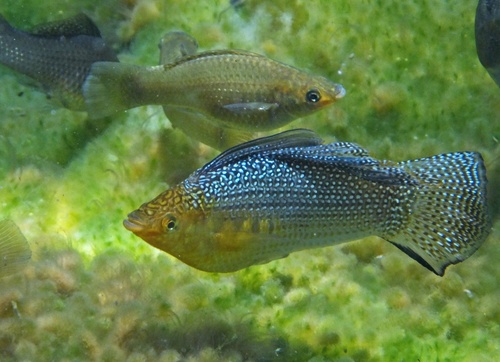
Its most notable trait is the dorsal fin, which has 18 to 19 rays; in males, it grows exceptionally tall, taller than the head, and is proportionally larger than the dorsal fin of any other molly species. The dorsal fin has a long base that extends across most of the back.
Anal Fin Traits
The anal fin holds 10 rays.
Paired Fin Traits
Pectoral fins are roughly the same length as the head, while pelvic fins reach the front of the anal fin; in males, one pelvic ray is elongated and matches the length of the gonopodium.
Caudal Fin Shape
The caudal (tail) fin is most often rounded, though some individuals have a slight extension at the lower corner.
Male Morph Classes
Males are polymorphic in size and color, and can be broadly grouped into three classes: large ornamented males, intermediate ornamented males, and cryptic intermediate males, named for their habit of hiding among females.
Base Body Color
The species' overall base body color is olive-green.
Anterior Body Markings
Three or four dark vertical bars are present near the front of the body, though most are obscured by the pectoral fins.
Lengthwise Body Stripes
Dark brown lengthwise stripes run along the back and sides, with broader stripes aligned to the scale rows and narrower stripes between them.
Scale Spot Pattern
Between these stripes, two pearl-like white spots sit on each scale, forming a distinct shimmering pattern that is particularly bright in males.
Dorsal Fin Coloration
The dorsal fin is dark and covered in numerous pale spots; males often have a row of larger dark spots near the fin's outer edge.
Caudal Fin Coloration
The tail fin is usually mostly plain, though some individuals have spots on the upper section, while the lower section remains unmarked and has a black edge.
Taxonomic Distinction from P. kykesis
P. velifera is closely related to P. kykesis, but can be told apart by its larger head, lower scale count, distinct coloration, and most importantly, its unusually large dorsal fin.
Native Range Core
Poecilia velifera is native to the coastal waters of Mexico's northern Yucatán Peninsula. Its natural range spans the Atlantic slope, covering coastal habitats in the Mexican states of Yucatán, Quintana Roo, and Campeche, as well as the islands of Mujeres and Cozumel.
Gulf of Mexico Range Limit
On the Gulf of Mexico slope, the species occurs south to a tidal stream approximately 50 km (31 mi) southwest of San Francisco de Campeche, north of latitude 19°30′ N.
Inland Range Status
All reported records of the species from Yucatán's inland waters may represent introduced populations.
Additional Native Locations
The species has also been recorded in the marine park at Contoy Island. It is known from a total of nine locations, all situated no more than roughly 20 m (66 ft) above sea level.
Habitat Salinity Preference
The Yucatán molly occupies a wide range of coastal and near-coastal habitats, primarily in marine and brackish environments.
Habitat Types
It is commonly found in lagoons, estuaries (such as Ria Lagartos), tidal streams, salt marshes, mangrove channels, coastal cenotes (karst sinkholes), and freshwater pools. It also occurs in freshwater cenotes in the peninsula's interior; these populations may be the result of either human introduction or recent colonization following hurricane flooding.
Habitat Water Clarity
Water in its habitats ranges from clear to turbid, including green and dark tea-stained waters colored by decaying vegetation.
Habitat Current Regime
Currents in these habitats are typically weak or entirely absent.
Habitat Partitioning with P. kykesis
This species' habitat preference distinguishes it from P. kykesis, the other sailfin molly native to Yucatán, which prefers inland freshwater rivers and reservoirs.
Co-occurrence with P. orri
P. velifera may however co-occur with the shortfin molly P. orri in freshwater cenotes.
Substrate Types
P. velifera lives over a diverse range of substrates, including sand, mud, fine loose silt, shell debris, accumulations of decaying plant material, gravel, and rock.
Habitat Vegetation Presence
Some habitats lack plant growth, but vegetation is more commonly present.
Coastal Habitat Vegetation
Where it occurs, vegetation typically includes algae such as Chara, mangroves, Typha, and Potamogeton.
Cenote Habitat Vegetation
In freshwater cenotes, plant communities may also include water lilies, Myriophyllum, and Utricularia.
Typical Depth Range
Individuals are usually found in shallow water, typically less than 1 m (3.3 ft) deep. In some inland cenotes, however, adults have been recorded at depths as great as around 3 m (9.8 ft).
Threat Sources
Habitat loss and degradation are potential threats to Poecilia velifera, including altered water flow, channel modification, pollution, and sediment accumulation across its range.
Population Decline
Its overall population is declining; over approximately 20 years, urbanization and highway construction have eliminated two of the roughly 28 known subpopulations.
Conservation Status
As a result, the International Union for Conservation of Nature lists P. velifera as a vulnerable species.
Global Introduced Range
Introduced populations of Yucatán molly, originating from fish farm escapes or intentional releases from home aquariums, have been recorded in Libya, Singapore, Colombia, Taiwan, Israel, Minas Gerais, Thailand, and Peru.
Thailand Introduction History
In 1987, Thailand imported more mollies from Taiwan to control algae in shrimp farms near the mouth of the Chao Phraya River; by 2002, a self-sustaining wild population had become established in a brackish section of the river.
Reproductive Behavior Overview
Reproductive behavior in Poecilia velifera combines active pursuit, courtship displays, and both consensual and opportunistic mating attempts.
Male Mating Strategy by Size
Smaller males typically use sneak copulations, carrying out rapid forced inseminations without courtship, while larger males combine these thrusting attempts with conspicuous courtship.
Male Pursuit Behavior
Males often initiate interactions by rapidly chasing females, either alone or in groups. This vigorous pursuit is frequently competitive, and may lead to mating attempts directed at females already being courted by other males.
Gonoporal Nibbling Behavior
During close interactions, males may make brief physical contact with the female's genital opening, a behavior called gonoporal nibbling.
Courtship Display Traits
Courtship displays are elaborate and visually obvious: a male positions himself in front of or beside a female, fully extends his dorsal fin, and often curves his body into a distinct S-shape while tilting toward her.
Display Behavior by Morph Class
These displays are mainly performed by large ornamented males; intermediate ornamented males generally only display when larger competitors are not present.
Consensual Mating Process
Mating attempts involve the male positioning himself behind the female, swinging the gonopodium forward while swimming alongside or slightly below her, and attempting to insert the gonopodium's tip into the female's gonopore to transfer sperm.
Opportunistic Mating Tactics
Males also use opportunistic tactics. A male may rush toward a female that is already being courted by another male and attempt a quick gonopodial thrust from behind, mating without prior display. Similar thrusting attempts are also directed at females that are not being courted.
Sneak Mating Disruption
In turn, courting males may be disrupted when rivals use these moments to attempt sneak inseminations while the primary courting male is engaged in display.
Cryptic Male Mating Advantage
By associating with female shoals instead of fighting rivals, cryptic males are able to attempt copulation more often than large males.
Female Mate Preference
Females prefer large males.
Breeding Season
Breeding generally occurs from late February to late July, and in some cenotes reproductive activity may take place nearly year-round.
Reproductive Output
Females give birth to 20–50 live young at intervals of three to five weeks.
Hybridization Background
Poecilia velifera and the shortfin molly P. mexicana, which co-occur at one site in Campeche, have long been known to produce viable, fertile hybrid offspring in laboratory conditions, but no wild hybrids were collected over more than three decades of extensive survey work.
Wild Hybrid Discovery
The occurrence of rare natural hybridization between the two species was only confirmed in 2004, when two hybrid specimens were caught: one early-generation hybrid confirmed to be the offspring of a male P. velifera and a female P. mexicana, and one later-generation hybrid.
Hybridization Driver
Laboratory tests show that female shortfin mollies prefer larger sailfin males to conspecific shortfin males, which may occasionally break down the behavioral barriers that normally prevent crossbreeding.