About Podocarpus drouynianus F.Muell.
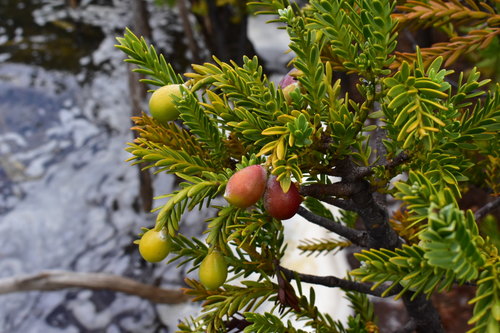
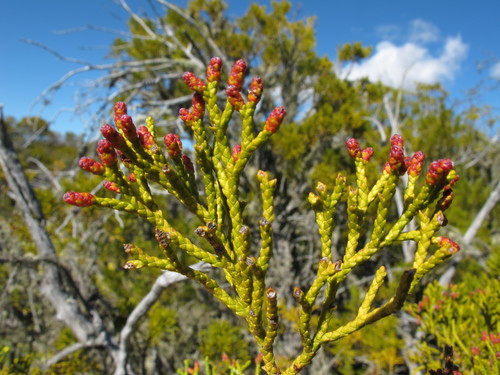
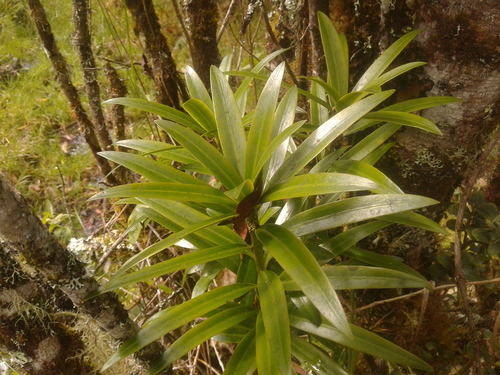
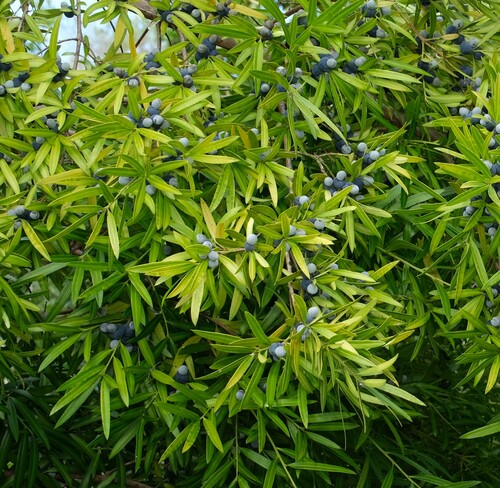
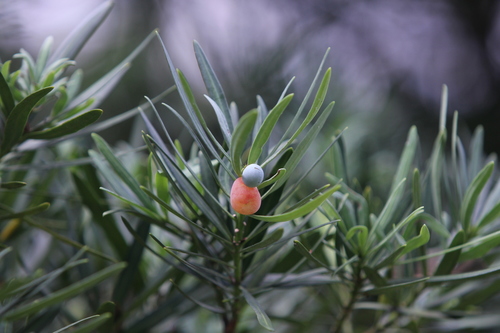
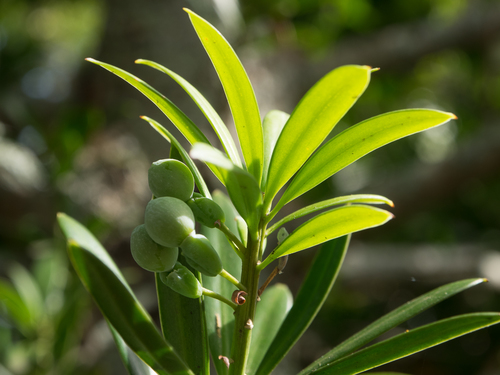
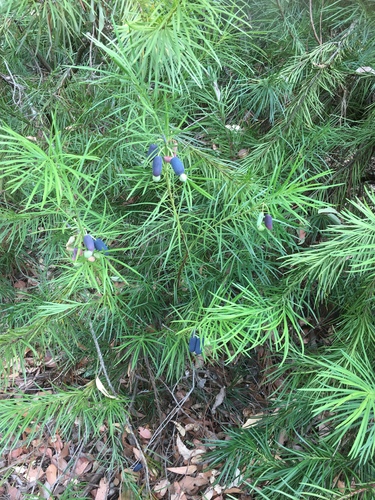
Podocarpus drouynianus F.Muell. is most commonly a shrub that rarely develops a single trunk; instead, it grows multiple branches from its base. Resembling a conifer, it typically reaches a height of 0.75 to 3 metres (2 to 10 ft), and forms clumps a few metres wide. This species is dioecious and grows very slowly. Its bark is thin and fibrous, starting green in colour and turning red-brown on the outer surface. The leaves are needle-like, 4 to 8 centimetres (1.6 to 3.1 in) long, and sharply pointed; they are green on the upper surface, and have glaucous stomatal bands on the underside. It produces berry-like cones, with a fleshy, edible purple aril that is 2 to 2.5 cm (0.79 to 0.98 in) long. Each cone holds one apical seed (rarely two) that is 1 cm (0.39 in) long. This species grows on lower slopes, low-lying areas, and around creeks in the South West and Great Southern regions of Western Australia, where it occurs in loamy, sandy, or gravelly soils. It grows as an understorey species in lowland jarrah and karri forest, and spreads mostly via root suckering. The total extent of occurrence of the species is less than 20,000 square kilometres (7,722 sq mi), spread across multiple locations. The total area of occupancy of P. drouynianus has been reduced by clearing of forest for pasture, and the replacement of native forest with exotic species. For cultivation, Podocarpus drouynianus ideally should be grown in partial shade with plenty of water. Unusually for this genus, it tolerates fairly dry conditions. It can survive temperatures as high as 45 °C, and grows well in both full sun and partial shade. In cultivation, it grows into a rounded form, slowly reaching two metres in height and 1.5 metres in width. It is usually propagated from cuttings for planting. This plant does not reliably produce its attractive red fleshy fruit, but it is popular for its appealing foliage. Its long leafy stems are harvested for use in the florist industry. Its plum-like fruit is edible, though it has no distinctive taste, and it is recorded as an important food source for the first peoples of Southwest Australia.