About Podaxis pistillaris (L.) Fr.
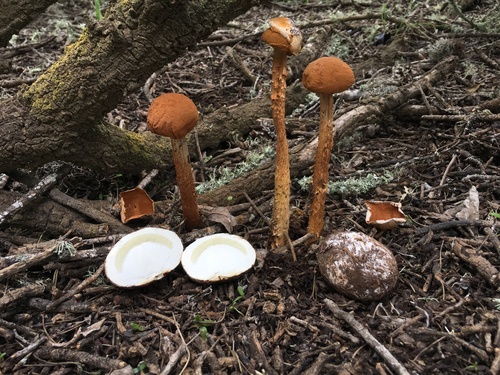
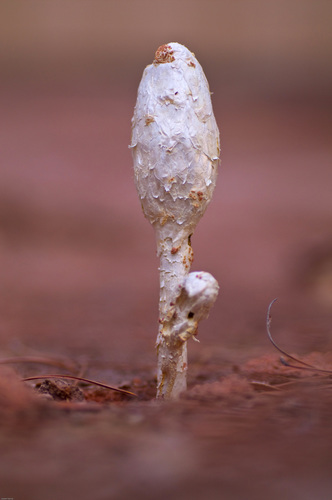
This species' fruiting body has a pod-shaped cap that can grow up to 11 centimetres (4+1⁄4 inches) tall, paired with a hard, woody stem. The large cap protects the blackish spore-bearing tissue; it develops scales, splits open, and usually falls away entirely when the species reaches maturity, which allows wind to disperse the spores. When a spore print can be obtained, it is dark brown to black. Spores typically measure 10–14 (–16) by (8–) 9–12 micrometres; they are broadly oval to sub-globose, smooth, and yellow to deep reddish-brown, with a double wall, a truncate base, and an apical pore. Older published spore measurements have varied widely. Specimens collected in Australia appear to have more subglobose spores than specimens collected in the United States, which suggests these two populations may not belong to the same species.
Large groups of this species often appear after heavy soaking rains. It grows well in deserts and semi-deserts across Australia and North America. In South Africa, it is often found growing on termite mounds. On the Hawaiian islands, it is commonly found along roadsides and in disturbed areas on the dry sides of the islands, especially in the Kona area of Hawaii Island and the Kihei area of Maui. David Arora has recorded the species' presence near the Taj Mahal in India.
This species is not poisonous, but it is not commonly consumed. It is reported to be edible when young and still white on the inside. Cultivating this species is reportedly difficult. In Australia, many desert Aboriginal tribes used this species to darken the white hair in old men's whiskers, and for body painting. It is presumed to have been used by many desert Aboriginal groups across the continent, due to its broad distribution across Australia's drier regions. There are also reports that it was used as a fly repellent. In addition to the ground-growing P. pistillaris, Australia is home to one other Podaxis species, P. beringamensis, which grows on termite mounds; both species were presumably used for these traditional purposes. Like many puffball-type fungi, this species can be used to dye textiles, producing either a tan or reddish hue. This dye requires an alkaline base; many home dyers currently use ammonia, while urine was used for this purpose in earlier times.