About Podarcis bocagei (Lopez-Seoane, 1885)
Common and Scientific Name
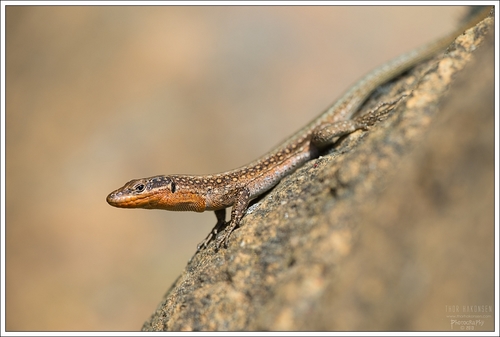
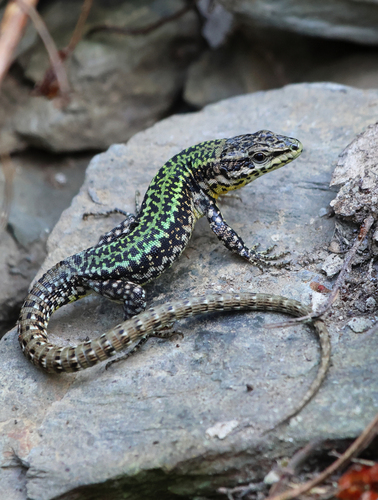
Bocage's wall lizard, scientifically named Podarcis bocagei, reaches a snout-to-vent length (SVL) of about 7 cm (2.8 in), with a tail that is twice the length of its snout-to-vent measurement.
Sexual Size Dimorphism
Males of this species are larger than females.
Body Shape
It is a sturdy, somewhat flattened lizard that resembles Carbonell's wall lizard (Podarcis carbonelli).
Dorsal Coloration
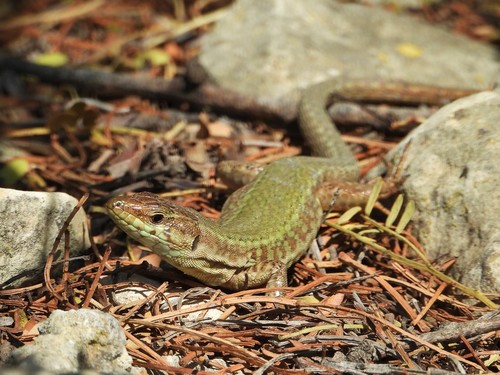
Its dorsal surface is usually grey or yellowish-brown, though males sometimes have green dorsal colouring, and it is heavily marked with rows of dark speckles.
Flank Coloration
Its flanks may be brownish or yellow.
Underpart Coloration
The underparts are white, yellow, pink, or orange; unlike Carbonell's wall lizard, this species does not have the small blue spots along the edge of the belly that are often present in P. carbonelli.
Geographic Range
Bocage's wall lizard is distributed in northern Portugal and northwestern Spain, ranging as far south as the River Douro.
Habitat Types
Its typical habitats include open deciduous woodland, scrubland, coastal sand dunes, and cultivated areas, and it can also be found within villages.
Altitudinal Range
It occurs at altitudes from sea level up to 1,900 m (6,200 ft).
Reproductive Mode
This species is oviparous.
Clutch Characteristics
Sexually mature females produce 2 to 4 clutches of eggs each year, and clutch size ranges from 2 to 9 eggs.