About Poa trivialis L.
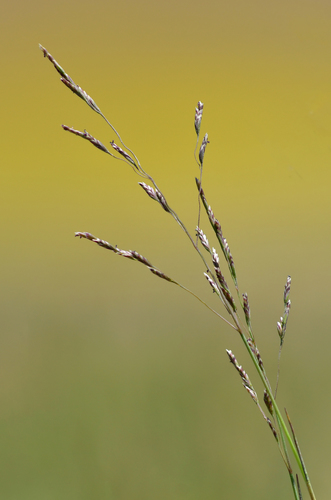
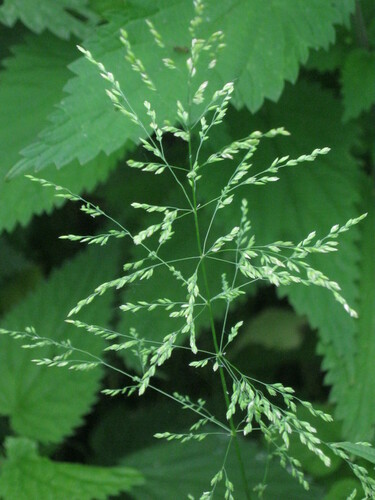
Poa trivialis L. is very common in meadows and pastures across Britain. Its preferred habitat is moist, sheltered locations. It produces abundant herbage that is fairly nutritious, though less nutritious than the herbage of Poa annua or Poa pratensis. It is useful for grazing on heavy, damp soil. It also tolerates polluted urban atmospheres very well. It flowers from June through the rest of the summer. It is often classified as a weed on golf courses, and it is an invasive species in the Great Lakes region, where it was first recorded in 1843. This grass has short stolons. Its leaves are broad and tapering, and its leaf sheathes are very rough. Its leaves are shiny, a trait it shares with Lolium perenne and crested dog's-tail. It has pointed ligules that measure 4–10 mm (3/16 – 3/8 in) long. This differs from the ligules of Poa annua (annual meadow grass), which are silvery and pointed, and Poa pratensis (common meadow grass), which are short and blunt. Its roughish, slender stem grows 30 to 60 cm (1 to 2 ft) high. By contrast, Poa annua (smooth meadow grass) has a smooth stem. It has a loose, much-branched, whorled green panicle that reaches 15 cm (6 in) long. Its spikelets are egg-shaped. Poa trivialis is also commonly called Orcheston grass, named for a village located on Salisbury Plain.