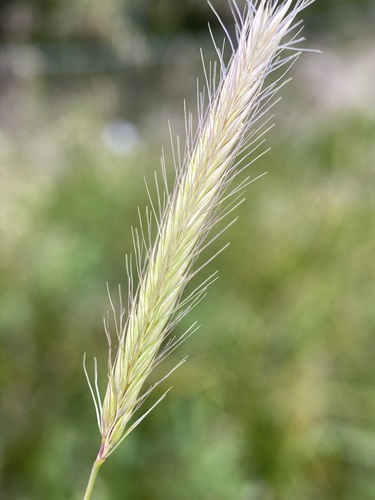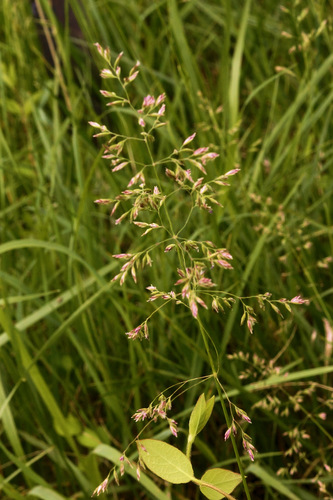
About Poa pratensis L.
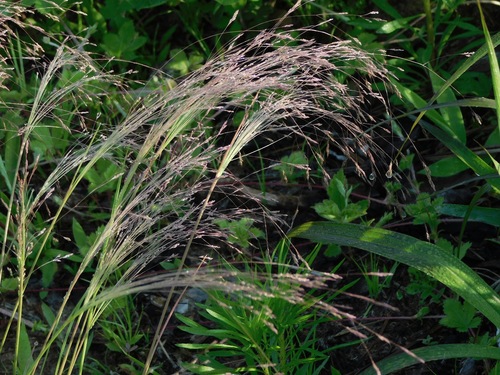
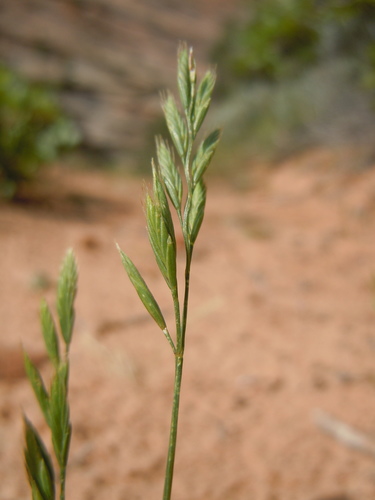
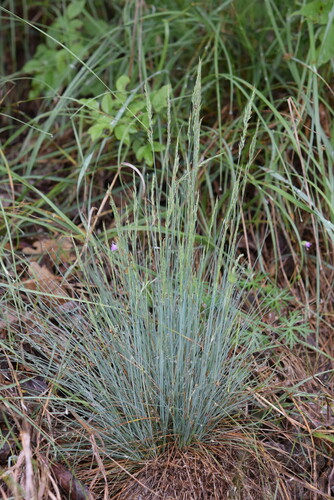
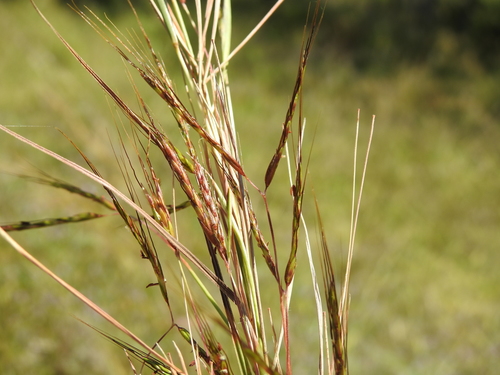
Poa pratensis L. is a herbaceous perennial plant that grows 30–70 centimetres (12–28 inches) tall. Its leaves have boat-shaped tips, are narrowly linear, and grow up to 20 centimetres (8 inches) long and 3–5 millimetres (0.12–0.20 inches) broad. The leaves are either smooth or slightly roughened, with a rounded to truncate ligule 1–2 millimetres (0.039–0.079 inches) long. Poa pratensis has a fairly prominent mid-vein running down the center of each leaf blade. The extremely short, square-ended ligule creates a clear contrast with the pointed, silvery ligules of related species Poa annua (annual meadowgrass) and Poa trivialis (rough meadowgrass). Its foliage is dark green to blue, differing from the apple-green color of both P. annua and P. trivialis. This species produces a conical panicle 5–20 centimetres (2–8 inches) long, with 3 to 5 branches in the basal whorls. The oval spikelets are 3–6 millimetres (0.12–0.24 inches) long and hold 2 to 5 florets; their color is purplish-green or grey. Flowering occurs from May to July, which differs from annual meadowgrass (Poa annua), which flowers for eight months each year. Poa pratensis has a creeping rootstock with rhizome runners. Its broad, blunt leaves tend to spread near the plant base, forming dense, close mats. In ecology, Poa pratensis is a food source for the caterpillars of three butterfly species: meadow brown (Maniola jurtina), gatekeeper (Pyronia tithonus), and pepper-and-salt skipper. It is also eaten by a number of other insects: adult common sun beetles (Amara aenea) feed on its developing seeds; the leafhopper Eupelix cuspidata uses it as a host; grassbug Myrmus miriformis feeds on its young blades and developing seeds; and club-horned grasshopper (Aeropedellus clavatus) feeds on its blades, seeds, and glumes. Poa pratensis acts as a host for multiple fungi species, including Claviceps purpurea, which causes ergotism in humans and animals that consume infected plant material, plus Drechslera poae, Epichloë typhina, Phaeoseptoria poae, Puccinia brachypodii var. poae-nemoralis, Stagonospora montagnei, Stagonospora nodorum, and Wojnowicia hirta. For cultivation and production, the Central Kentucky Blue Grass Seed Company Building is listed on the National Register of Historic Places. Since the 1950s and early 1960s, 90% of all Kentucky bluegrass seed produced in the United States has come from specialist farms located in Idaho, Oregon, and Washington. During the 1990s, botanists began experimenting with hybrids of Poa pratensis and Texas bluegrass (P. arachnifera), with the goal of developing a drought- and heat-resistant lawn grass. In warm climates, these hybrids can stay green year-round. Bella Bluegrass is a branded dwarf variant of Poa pratensis developed by the University of Nebraska–Lincoln. It has relatively deep roots and spreads relatively quickly horizontally via its root system, but only reaches 2–5 inches (5–13 cm) in above-ground height. This low height essentially eliminates the need for mowing on lawns planted with this variant. Bella Bluegrass cannot be reproduced from seed, so its production relies on sod plugs or sprigging.