About Pluvianus aegyptius (Linnaeus, 1758)
Taxonomy and Naming
The Egyptian plover, with the scientific name Pluvianus aegyptius (Linnaeus, 1758), is a striking and unmistakable bird species.
Adult Size and Markings
Adults measure 19–21 cm (7.5–8.3 in) in length, and have a black crown, back, eye-mask, and breast band. The rest of the head is white.
Plumage Coloration
The remaining upperpart plumage is blue-grey, and the underparts are buff. The moderately long legs are also blue-grey.
Plumage Variation
Males and females have similar plumage, but juveniles are duller, with their black markings mixed with brown. There is no seasonal variation in the bird's plumage.
Upperparts in Flight
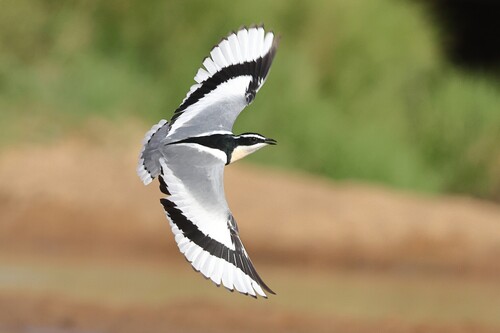
In flight, the black crown and back contrast with the grey of the upperparts and wings. The flight feathers are brilliant white and crossed by a black bar.
Underparts in Flight
From below, a flying Egyptian plover is entirely white, except for its buff belly and black wing bar. The end of its tail has a white band.
Post-Landing Greeting Behavior
After landing, paired individuals greet each other by raising their wings in an elaborate ceremony that displays their black and white markings.
Vocalization
The species' most common vocalization is a high-pitched krrr-krrr-krrr.
Distribution Range
The Egyptian plover is a localized resident bird found in tropical Sub-Saharan Africa, ranging from Senegal in the west to Ethiopia in the east, and extending south into parts of the Democratic Republic of the Congo.
Breeding Habitat
It breeds on sandbars in large rivers and avoids forested areas.
Absence from Egypt
Despite its common name and scientific name referencing Egypt, the species is not present in modern-day Egypt.
Social Structure
This is a relatively tame bird, found in pairs or small groups near water.
Diet Composition
The Egyptian plover feeds mainly on invertebrates, including worms, molluscs, aquatic insects, and small flies.
Feeding Behavior
It picks food from surfaces and probes damp sand with its bill, and will sometimes catch insects in mid-air.


