About Plumeria rubra L.
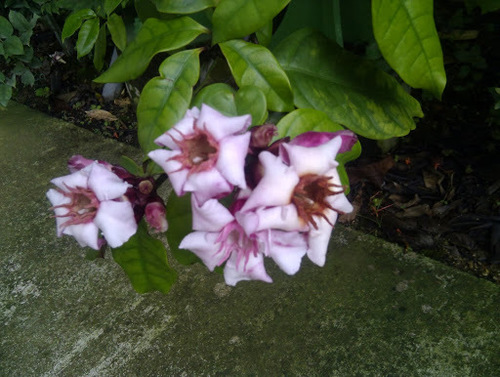
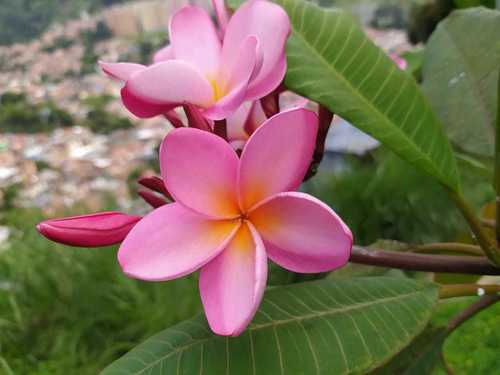
Plumeria rubra L. is a species in the dogbane family, growing as a spreading shrub or small tree. It reaches 2–8 m (5–25 ft) in height, with a similar spread. It has a thick succulent trunk and sausage-like blunt branches covered with thin grey bark. The branches are somewhat brittle; when broken, they ooze a white latex that can irritate the skin and mucous membranes. This latex, found in the plant's stems, is toxic, but not deadly unless consumed in large quantities. Its large green leaves can grow 30 to 50 cm (12 to 20 in) long, are arranged alternately, and clustered at the ends of branches. In the wild, the trunks of these plants can reach up to 25 cm in diameter; cultivated plants tend to be smaller. This species is deciduous, dropping its leaves during the cooler months of the year. Flowers grow at the ends of branches over summer, are often profuse and very prominent, strongly fragrant, and have five petals. They release their fragrance in the morning and evening, with a scent similar to rose, citrus, and cinnamon. Flower color ranges from the common pink to white, usually with yellow shades in the center. Flowers are initially tubular before opening out, and reach 5–7.5 cm (2–3 in) in diameter. The species only rarely produces seed: 20 to 60 winged seeds are contained in a 17.5 cm (7 in) cylindrical pod, and fruits are very rarely found on cultivated plants. The native range of Plumeria rubra extends from Baja California into central Mexico, south through Central America (Costa Rica, Nicaragua, Guatemala, El Salvador, Belize, Honduras, Panama) to the Department of Antioquia in Colombia and Venezuela in South America. It is widely cultivated in tropical and subtropical regions around the world, and has become naturalized across most of tropical Asia and the Pacific Islands. It was introduced to the Philippines in the 1560s during Spanish colonial rule, and spread from there to the rest of Southeast Asia and other parts of Asia. It was also introduced to the Pacific Islands in the late 19th century, where it has become iconic for its use in leis. Plumeria rubra typically inhabits hot, rocky areas with dry to moderate rainfall. It can survive in locations with prominent dry seasons, where it will flower on bare branches, or in more humid conditions, where it can stay evergreen. It can also be found in rocky forests, mountain slopes, and occasionally on plains or savannas. It grows at elevations from sea level to 1000 meters, and has been found as high as 1500 meters. This species is cultivated worldwide in subtropical and tropical climates. In Australia, it is widely grown in Sydney, Perth, and warmer frost-free climates further north. In the mainland United States, it tolerates USDA Hardiness zones 10B to 11, which include southern coastal California and the southern tip of Florida. It is also grown in Hawaii up to an altitude of 2000 m. It tolerates a wide variety of soils, ranging from acid to alkaline, and sandy to clay. It grows best in dry to medium moisture, well-drained soils in full sun, and will bloom through most of the year in tropical regions. It does not grow well in wet soils; in areas with winter temperatures below 10 °C (50 °F), plants stop blooming and shed their leaves. Established plants are very salt tolerant, and can withstand even salt-laden winds. Widely available in nurseries, frangipanis (the common name for this plant) are easily propagated by branch cuttings taken in cooler months and left to dry for a week or more. Aside from garden, street, and park planting, frangipanis are also planted at temples and cemeteries. It is an important crop in Hawaii; over 14 million of its flowers were sold for lei use in Hawaii in 2005. In temperate regions, P. rubra must be grown under glass, in a large conservatory or similar space, due to its need for warm conditions, though it can be placed outside in a sheltered sunny spot during the summer months. In the United Kingdom, it has earned the Royal Horticultural Society's Award of Garden Merit. Some cultivated forms are hybrids between P. rubra and Plumeria obtusa; these hybrids have rounded rather than pointed leaves, and are less likely to be deciduous. The white-and-yellow-flowered 'Singapore' cultivar, originating in the United States, usually retains its leaves year-round in Hawaii. Coleosporium plumeriae, commonly called plumeria rust or frangipani rust, is a fungus that attacks the young leaves of P. rubra. It causes a brownish or orange powdery coating or blistering on leaves. It has been recorded in Hawaii and on the east coast of Australia. It was first identified by French mycologist Narcisse Théophile Patouillard on Guadeloupe Island in the eastern Caribbean in 1902, and had reached Taiwan by 2005. The USDA Forestry Service lists Plumeria rubra as a poisonous plant, and warns against touching or eating any part of the plant. In Cambodia, like other Plumeria species, P. rubra flowers are used for necklaces, as offerings to deities, or as decoration for coffins. Its leaves are used to care for sores, and made into soothing infusions. In traditional Chinese medicine, its flowers and bark are used to treat fever, bacillary dysentery, pertussis, and other conditions. Chinese herbal teas such as Wang Lao Ji contain P. rubra. P. rubra contains fulvoplumierin, an antibiotic that inhibits the growth of Mycobacterium tuberculosis. Studies have shown the plant also has antifungal, antiviral, analgesic, antispasmodic, and hypoglycemic properties. It also contains reported compounds including agoniadin, plumierid, plumeric acid, cerotinic acid, and lupeol; its stem contains an alkaloid called triterpinoid. The plant is reported to support digestion and excretion, as well as respiratory and immune functions. Its sap is used as a laxative, and as a remedy for bloating and stomachaches. Its bark is said to be purgative, and is also used to treat venereal sores. Its flowers can be boiled in water or juice and made into a salad to promote bowel movement, urine flow, and to control gas and phlegm. Flowers are also used to treat asthma. On the Hawaiian island of Molokai, P. rubra is cultivated to produce neck garlands called leis. In many Pacific islands including Hawaii, its flowers are used to make scented coconut oil. Its bark has faint purplish streaks; its wood is hard, compact, with a very fine texture, and takes a high polish.