About Plukenetia volubilis L.
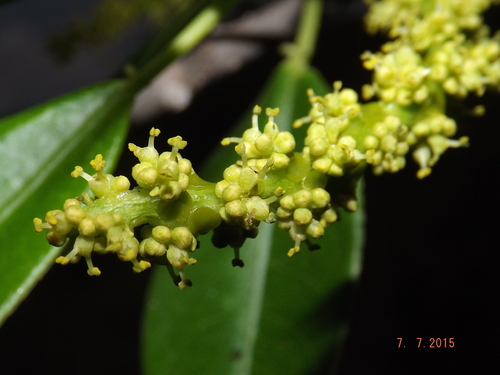
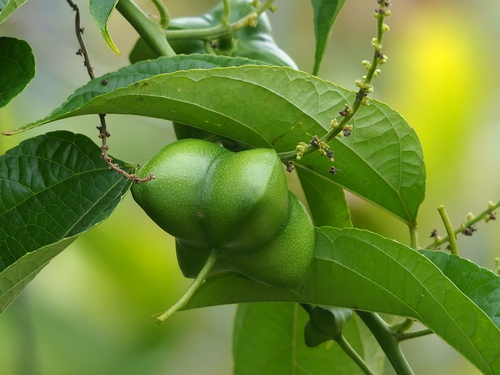
Plukenetia volubilis L. is a plant that grows up to 2 meters (6 1⁄2 feet) tall. It produces alternate, heart-shaped, serrated leaves that measure 10 to 12 centimeters (4 to 4 3⁄4 inches) long and 8 to 10 centimeters (3 1⁄4 to 4 inches) wide, with leaf stalks (petioles) 2 to 6 centimeters (3⁄4 to 2 1⁄4 inches) long. This plant flowers five months after planting, and develops seeds around the eighth month of growth. Its small white male flowers grow in clustered arrangements, while two female flowers develop at the base of the inflorescence. In tropical regions, it often grows as a vine that needs support, and produces seeds nearly year-round. Its fruits are capsules 3 to 5 centimeters in diameter with 4 to 7 pointed projections. The capsules are green when unripe and ripen to a blackish brown color. Ripe fruits hold a soft, wet black pulp that is messy and inedible, so fruits are typically left to dry on the plant before harvest. By two years of age, this plant can often produce up to one hundred dried fruits per harvest, yielding 400 to 500 seeds several times a year. Fruit capsules most commonly have four to five lobes, though some may have as many as seven. Inside the capsules are oval, dark brown seeds 1.5 to 2 centimeters in diameter, each weighing 0.45 to 1.00 grams. The seeds' cotyledons are open, similar in appearance to those of almonds, and covered with a thin whitish film. This species is native to most of tropical South America, including Suriname, Venezuela, Bolivia, Colombia, Ecuador, Peru, and northwestern Brazil, as well as some of the Windward Islands in the Caribbean. Indigenous people in the Peruvian Amazon rainforest have cultivated Plukenetia volubilis for centuries. It grows in warm climates at altitudes up to 1,700 meters (5,500 feet), provided it has consistent access to water and good soil drainage. It grows best in acidic soils and on alluvial flats near rivers. It is also grown commercially in Southeast Asia, most prominently in Thailand. When raw, the seeds and leaves of Plukenetia volubilis contain notable amounts of alkaloids, saponins, and lectins, which may be toxic if consumed without cooking. These compounds are broken down and rendered harmless by roasting.