About Pluchea indica (L.) Less.
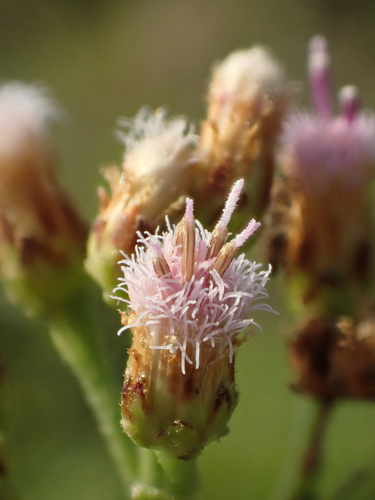
This species, Pluchea indica (L.) Less., is a branching shrub that grows up to 2 meters tall. Its toothed, oval leaf blades are papery but not thin, and often covered in a fine layer of hairs. Its flower heads grow in dense clusters, both in the leaf axils and at the tips of branches. The pinkish purple florets have long, protruding styles. Only florets along the edges of each flower head produce fruits. The fruit body is 1 millimeter in length, with a white pappus that is about 5 millimeters long. Its seeds are dispersed by wind. This plant most often grows in wet saline coastal habitats, including brackish marshes and mangroves. While it is not very competitive with other plant life, it can readily colonize coastal habitats, negatively impacting native and cultivated plants, and altering waterbird habitat. It is classified as invasive in New Caledonia, where it was introduced in 1967. This plant contains the compounds β-sitosterol and stigmasterol, both of which have antidiabetic properties. β-sitosterol isolated from the plant's root extract can also neutralize the venom of Russell's viper (Daboia russelii) and the monocled cobra (Naja kaouthia).