About Plexippus petersi (Karsch, 1878)
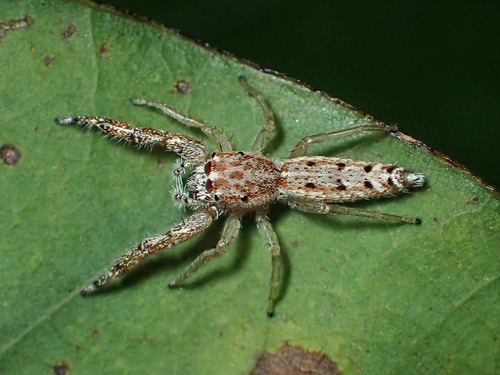
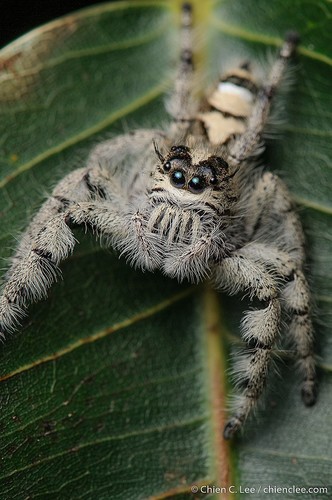
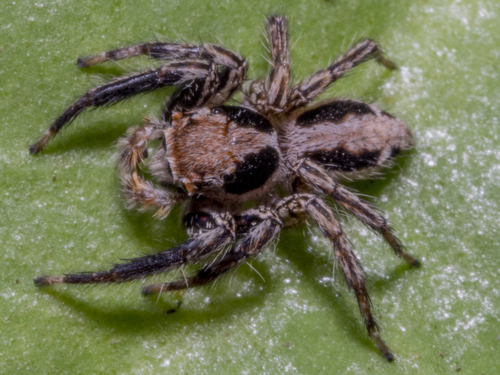
Male Plexippus petersi measure between 6 and 10 mm (0.24 and 0.39 in) in total length, while females are slightly larger. The head has four pairs of eyes: one pair is larger than the others, forward-facing, and movable, and the remaining six eyes are small and fixed in position. The cephalothorax is longer than it is wide, and is brown in color, with two darker reddish-brown bands running along its dorsal surface. The abdomen is twice as long as it is wide, with a yellowish-brown dorsal color and two longitudinal darker brown bands; these bands break apart near the posterior end to form a pair of orangish spots on either side. The ventral surface of the abdomen is yellowish-brown, and the spinnerets are greyish-brown. Pale regions of the abdomen are covered with whitish setae (bristles), while darker areas are covered with brown setae. The legs are yellowish-brown, streaked with darker brown and darker in color near the joints, and have blackish-brown leading edges. Scattered setae grow on the legs, and the femur bears a dense patch of brown hairs.
Plexippus petersi is native to Southeastern Asia. Its known distribution includes Africa, China, Japan, Indonesia, New Guinea, the Philippines, Vietnam, Laos, Cambodia, India, Sri Lanka, Malaysia and Australia.
This species is a house spider that lives indoors, and is noted for its skillful hunting of mosquitoes, flies and other invertebrates. It has also been found living in crops in the Philippines: it was recorded in a rice field infested with the armyworm Spodoptera mauritia, and in a corn field attacked by the northern armyworm Mythimna separata. Plexippus petersi has been investigated as a control agent for houseflies, and has shown potential as a bio-control agent.