About Plestiodon inexpectatus (Taylor, 1932)
Dorsal Stripe Pattern
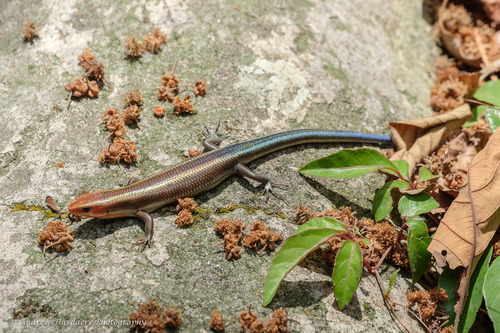
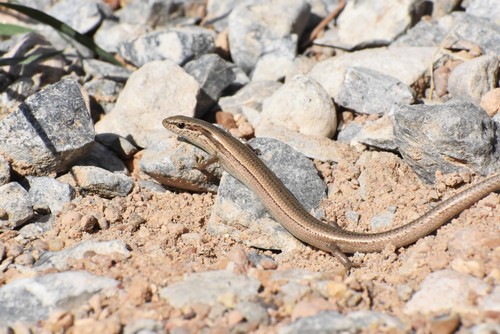
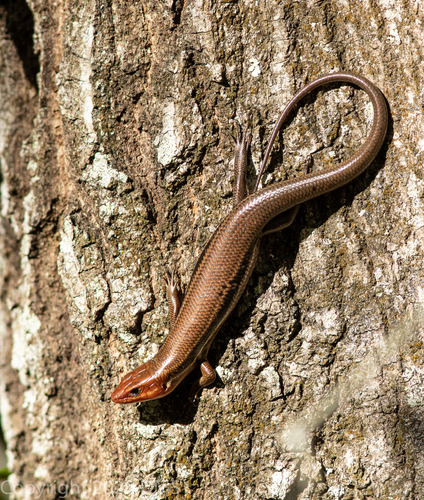
As their common name suggests, southeastern five-lined skinks (Plestiodon inexpectatus) have five characteristic narrow stripes along their bodies that lighten as the skinks age. The middle stripe is typically narrower than the other stripes, and the dark areas between the stripes are black in young skinks, but turn brown as they age.
Similar Species Comparison
A closely related similar species, the common five-lined skink (Plestiodon fasciatus), is slightly smaller than the southeastern five-lined skink and has broader stripes. Even with these physical differences, it is difficult to tell the two species apart based on physical appearance alone.
Juvenile Tail Coloration
Young southeastern five-lined skinks have a bright blue or purplish tail, particularly near the tip.
Juvenile Head Coloration
Their stripes also turn bright reddish orange close to the head. Juvenile coloration can last into adulthood, which gives the skink's head an overall orange-brown look.
Mainland Distribution
Southeastern five-lined skinks are common residents of wooded areas in the southeastern United States.
Island Distribution
They are also regularly found on small islands off the southeastern coast, even when these islands lack fresh water and vegetation.
Reproductive Mode
Southeastern five-lined skinks are oviparous, meaning they lay eggs.
Clutch Size Variation
Their clutch size ranges from 6 to 12 eggs, and the number of eggs decreases at higher latitudes.
Egg Parental Care
The female broods the eggs and protects them from predators, which includes other skinks.
Hatching Timeline
Hatchlings emerge around one month after the eggs are laid, which happens in early summer.