About Plemyria rubiginata (Denis & Schiffermüller), 1775
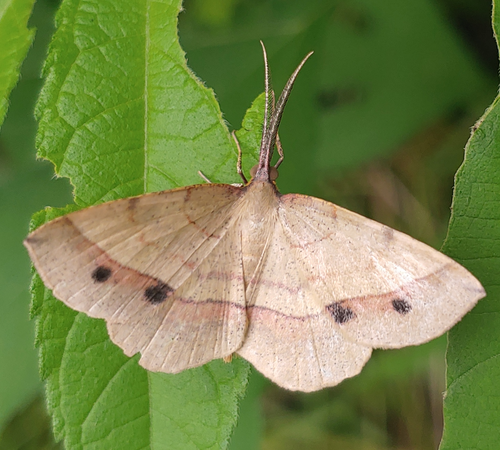
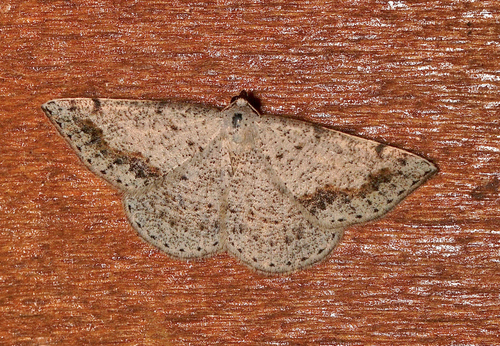
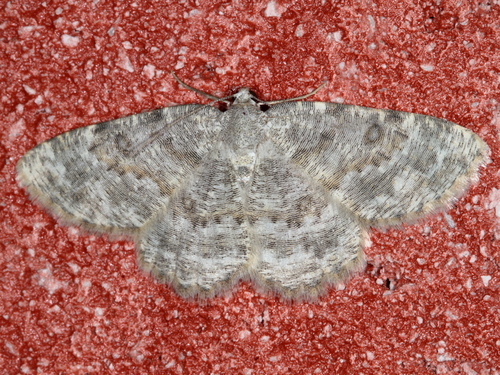
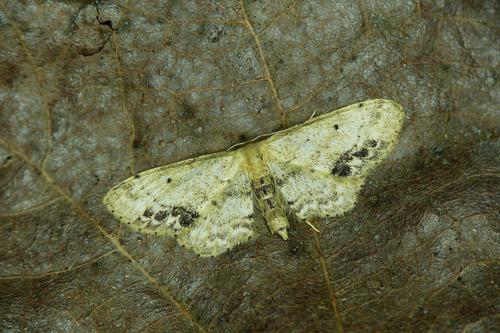
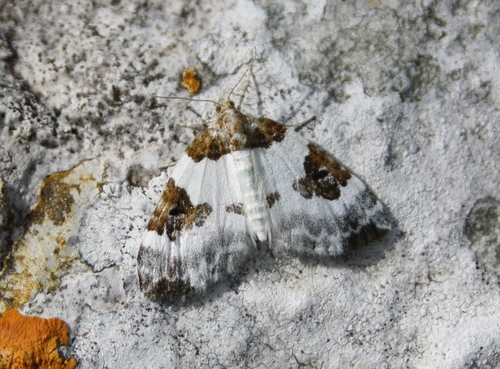
Plemyria rubiginata (Denis & Schiffermüller), 1775 has a wingspan of 22–28 mm. The forewings have a milky white ground colour, with a light brown to black-brown basal field. A prominent large light brown to black-brown stain stands out on the costa near the center, and this spot can vary in both intensity and shape. A blue-grey marginal band runs from the apex area, and usually continues in an attenuated form on the hindwings. A thin white squiggly line is visible within this band. Both forewings and hindwings each have a black discal fleck, which may sometimes be very unclear. This species is white, more glossy than any succeeding species in its group, yet more thinly scaled than ocellata. The forewing has a brown basal patch and brown anterior half of the median band, and both wings have a more or less well-defined bluish-smoky distal border. Several forms and aberrations are recognized: ab. parvula Retz has an extra dark spot at the middle of the forewing's hindmargin; in ab. guttata Huene, the median band is reduced to just a spot surrounding the discal dot; plumbata Curt. is a race native to Scotland and Northern England, with an uninterrupted or only very narrowly interrupted median band, usually with intensified smoky dark bordering, and sometimes shows traces of a narrow smoky band midway between the basal and median patches; ab. fumosa Prout is an extreme aberration that is not uncommon among the plumbata race, where the ground colour of the forewing is partially or wholly suffused with smoke-colour, sometimes deeply enough to almost completely obliterate the markings, and the hindwing may also sometimes be infuscated; maritima Strand is a Norwegian race that is smaller than the type, with a black-grey marginal band on the forewing that is not or scarcely interrupted; dahurica Stgr. from Dauria and Japan is yellowish white, with light brown basal and costal patches, and weak dark borders. Full-grown caterpillars are greenish, with several yellowish lines and stripes on the dorsum and sides, and have two short tips at the end of the body. The pupa is light green; shortly before moths hatch, the dark elements of the front wings show through the wing sheaths. Adult moths fly from June to early September, and the species overwinters as an egg in the fork of a twig. Larvae can be found from April to June, and are easily beaten from their foodplant during the day. They feed on a wide range of trees and bushes, including Alnus glutinosa (alder), Prunus spinosa (blackthorn), Betula species (birches), Crataegus monogyna (hawthorn), Prunus domestica (plum), and Malus domestica (apple). Preferred habitats are hedge areas, forests, orchards, and gardens. The species' distribution ranges across western and central Europe, including the British Isles, then continues through the temperate zone of the Palearctic to the Russian Far East, Siberia, and Japan. In the Alps, it occurs up to an elevation of 1500 metres.