About Pleiacanthus spinosus (Nutt.) Rydb.
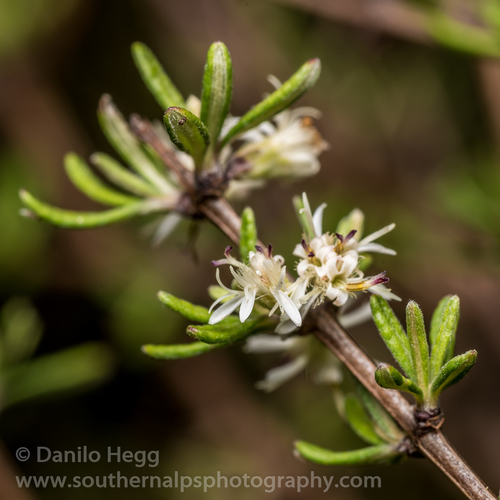
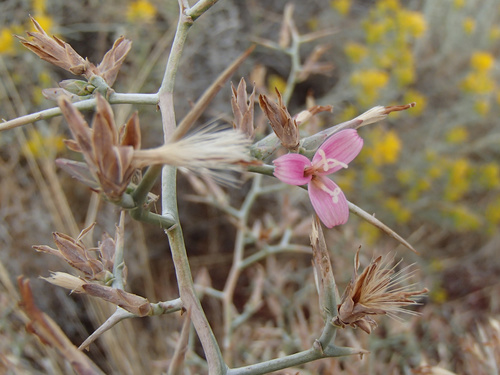
Pleiacanthus is a monotypic genus of flowering plants in the family Asteraceae, holding only one species: Pleiacanthus spinosus. This species was formerly classified as Stephanomeria spinosa, and its common names are thorn skeletonweed and thorny skeletonweed. It is native to the western United States, ranging from Montana and Idaho to southern California and Arizona. It grows in many types of mostly dry habitats, from deserts to mountains. This plant is a spindly subshrub that grows several slender stems up to 40 or 50 centimeters tall from a woody caudex. Stems divide many times into short, rigid branches that narrow to sharp thorn tips. The plant is mostly hairless, with the only exception being brownish woolly tufts at its base and below its basal leaves. Its lower stem holds small, linear leaves, while upper branches have leaves reduced to scale-like growths. Flower heads form near the ends of the branches. Each flower head has a cylindrical base wrapped in a single layer of phyllaries, and holds 3 to 5 ray florets. Each ray floret has an elongated tube and a pale to bright pink ligule. Its fruit is an achene tipped with a cluster of pappus bristles. Unlike the pappus bristles of Stephanomeria species, where this plant was previously classified, these bristles are not plumelike.