About Plectropterus gambensis (Linnaeus, 1766)
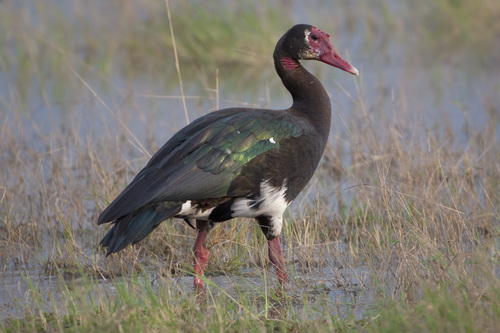
Plectropterus gambensis, commonly known as the spur-winged goose, has the following physical characteristics. Adult spur-winged geese measure 75–115 cm (30–45 in) in total length, with an average body weight of 4–6.8 kg (8.8–15.0 lb), and rarely reach up to 10 kg (22 lb). Males called ganders are noticeably larger than females. Their wingspan ranges from 150 to 200 cm (59 to 79 in). One source reports an average weight of around 6 kg (13 lb) for males and around 4.7 kg (10 lb) for females. However, 11 banded individuals from South Africa were found to average only 3.87 kg (8.5 lb), with a weight range of 2.4 to 5.4 kg (5.3 to 11.9 lb). Another South African study recorded 58 males with an average weight of 5.52 kg (12.2 lb) and average total length of 98.1 cm (38.6 in), while 34 females averaged 3.35 kg (7.4 lb) in weight and 84.2 cm (33.1 in) in total length. For standard body measurements, the wing chord is 42.5 to 55 cm (16.7 to 21.7 in), the bill is 5.7 to 6.4 cm (2.2 to 2.5 in), and the tarsus is 5.7 to 12 cm (2.2 to 4.7 in). This species counts among the largest true African waterfowl, only outsized by the wading Goliath heron, and is on average the world's largest "goose", though its average weight is rivaled at least by the Cape Barren goose. Spur-winged geese are more closely related to shelducks than to "true geese" from the Branta and Anser genera. Their plumage is mainly black, with a white face and large white wing patches, and their long legs are pinkish red. Beyond size, males differ from females by having a larger red facial patch that extends back from the red bill, plus a knob at the base of the upper mandible. This is generally a quiet species. Typically, only males produce calls, which are soft bubbling cherwit sounds when they take wing or are alarmed. Both sexes may give other quiet, inconspicuous calls during breeding displays or when alarmed. This species most often inhabits open grasslands near lakes, seasonal pools, rivers, swamps, and river deltas. It most commonly occupies large inland rivers and lakes, and generally avoids saline lakes and upland areas, though it can be found at elevations up to 3,000 m (9,800 ft) in eastern Africa. It is also not present in arid zones. The spur-winged goose is a gregarious species, usually forming small flocks of up to 50 birds. It occurs across a range of African rivers, lakes, and swamps. Large numbers of spur-winged geese may gather at varied sites to moult after breeding. This common species feeds by grazing, and rests beside water during the middle of the day. Its diet is mostly made up of plant material: the vegetative parts and seeds of grasses, sedges, and aquatic plants, plus agricultural grains, fruit such as figs, and tuberous crops. It may occasionally supplement its diet with small fish or insects. Geese may disperse to find new feeding opportunities outside the breeding season. The breeding season of spur-winged geese varies across their range: in the northern part of the range, breeding generally occurs from August to December, in eastern Africa from January to June, and in southern Africa from August to May. During the breeding season, this species is highly aggressive toward other waterfowl, including other spur-winged geese. Individuals use the spur on the bend of their wings violently during conflicts with other birds, and adult males are especially likely to attack other adult males. The large nest is usually hidden in vegetation near water, but the species also uses a wide range of alternative nesting sites including tree holes, rock cavities, old nests of hamerkops, African fish eagles, or social weavers, the top of termite mounds, and aardvark burrows. When nesting in trees, they usually choose a nest close to the ground, between 20 and 100 cm (7.9 and 39.4 in) high, on trees that are 3 to 4 m (9.8 to 13.1 ft) tall. They generally prefer quiet, undisturbed stretches of riverbank and wetland for nesting sites. Some populations of spur-winged goose are toxic. Populations that eat a large amount of blister beetles accumulate the poison cantharidin in their body tissues. Eating cooked meat from these toxic birds can cause poisoning in humans, and a 10 mg dose of cantharidin is lethal to humans.