About Plectorrhiza tridentata (Lindl.) Dockrill
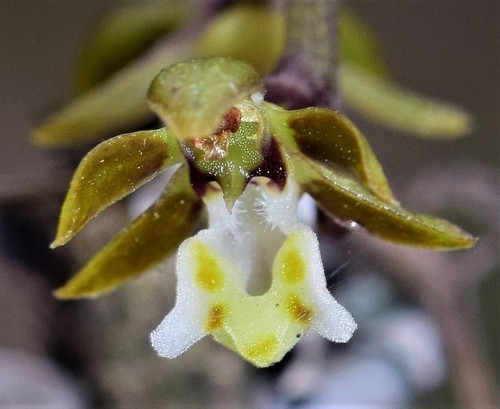
Plectorrhiza tridentata is an epiphytic or lithophytic herb. It has a single main flattened stem that is 100–300 millimetres (3.9–12 in) long, suspended by one to a few of its many tangled aerial roots. This species produces between three and twenty leaves that range from green to purplish. The leaves are leathery in texture, and their shapes range from narrowly elliptic to egg-shaped (sometimes with the narrower end toward the base) to oblong. Each leaf is 50–100 millimetres (2.0–3.9 in) long and 10–15 millimetres (0.39–0.59 in) wide. Between three and fifteen green or brown flowers are borne on a pendulous flowering stem that is 50–120 millimetres (2.0–4.7 in) long. Each flower is 5–6 millimetres (0.20–0.24 in) long and 6–8 millimetres (0.24–0.31 in) wide. The sepals and petals are separate from each other and spread widely apart. The dorsal sepal is 4–5 millimetres (0.16–0.20 in) long and about 2 millimetres (0.079 in) wide, while the lateral sepals are slightly longer. The petals are 4–5 millimetres (0.16–0.20 in) long and about 1.5 millimetres (0.059 in) wide. The labellum is white with a green patch, 6–7 millimetres (0.24–0.28 in) long and about 4 millimetres (0.16 in) wide, with three lobes. The side lobes are more or less triangular and curve outwards, and the blunt middle lobe has a curved spur about 2 millimetres (0.079 in) long. Flowering occurs from September to January. Plectorrhiza tridentata usually grows on trees in humid locations, including deep gullies and swamps. Its distribution extends from the Daintree area in Queensland, south along the coast and nearby ranges of New South Wales, to rainforest east of the Snowy River in north-eastern Victoria.