About Platyspiza crassirostris (Gould, 1837)
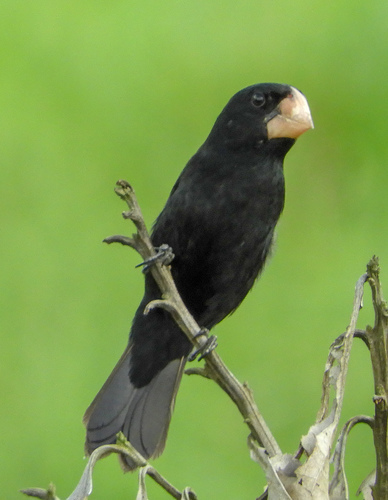
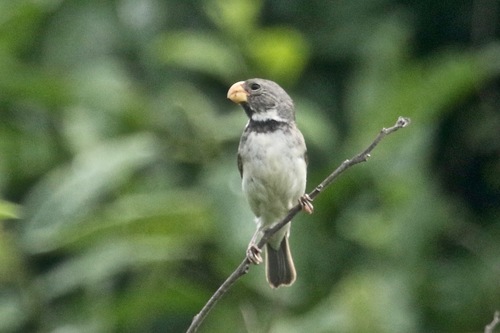
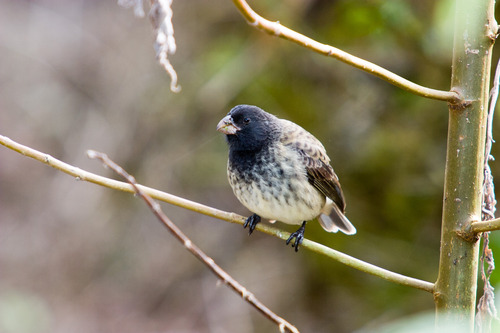
The vegetarian finch, scientifically named Platyspiza crassirostris, is one of the largest Galápagos finches. It measures 16 cm (6.3 in) in length, with a mass ranging from 29 to 40 g (1.0 to 1.4 oz). It has an upright stance described as "parrot-like", and a broad, stout beak with a strongly curved culmen. Adult males have olive-colored upper parts and whitish underparts, with smudgy streaking on the lower breast and flanks; some males have rufous coloring on the underparts. Their lower flanks and undertail coverts are buffy, and they have a black hood, throat, breast, and upper flanks. Their iris is dark; their bill is black during the breeding season, and horn-colored during the rest of the year. Adult females are principally brown above and off-white below, with a buffy rump and flanks. Brown streaking appears on the face, crown, upperparts, throat, breast, and flanks, and two indistinct buffy wingbars mark their brown wings. The female's beak is two-toned: the upper mandible ranges from dusky brown to black, while the lower mandible is dull orange or dull pink. Immature males have an appearance intermediate between adult males and adult females: they have blackish coloring on the face and throat, but are more heavily streaked on the underparts than adult males. The vegetarian finch is endemic to the Galápagos, where it is found on eight islands: San Cristóbal, Santa Cruz, Floreana, Isabela, Marchena, Santiago, Pinta, and Fernandina. While it previously occurred on Pinzón and Santa Fé, it is now extirpated from both of these islands. It occurs at elevations from 0 to 500 m (0 to 1,640 ft) above sea level. It is most common in montane evergreen forest, especially the transition zone, but its range also extends up into the humid zone and down into the arid zone.