About Platyrinchus mystaceus Vieillot, 1818
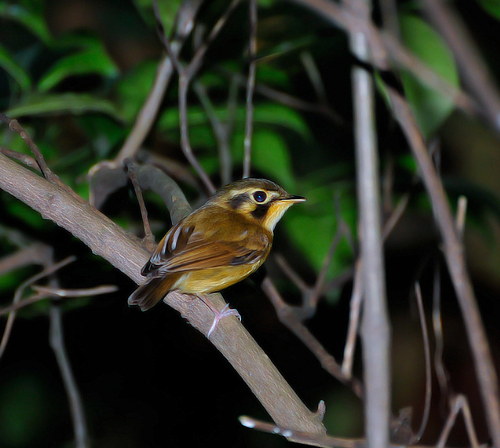
Platyrinchus mystaceus, commonly called the white-throated spadebill, measures about 9 to 11 cm (3.5 to 4.3 in) long and weighs 7.5 to 12 g (0.26 to 0.42 oz). It has a large head with a distinct bold facial pattern and a stubby tail. The sexes have nearly identical plumage, with the main difference found in the crown patch of the nominate subspecies. Males of the nominate subspecies P. m. mystaceus have a dark olive-brown crown with a partially hidden yellow central patch; females have a much smaller patch or no patch at all. For both sexes of the nominate subspecies, pale buff-yellow coloring forms a patch above the lores, an eye-ring, a stripe behind the eye, and a patch on the ear coverts. Their lores are dark blackish brown, and this color continues as a stripe beneath the eye and reappears as a patch on the ear coverts. Their upperparts, wings, and tail are olive-brown. Their throat ranges from whitish to pale yellow, and most of their underparts are creamy buff to ochraceous. Their breast and sides sometimes have a tawny to olive wash, and their belly carries an ochre tinge. Juveniles lack the crown patch; they have brighter rufescent upperparts than adults, with a pale grayish brown throat and breast and a buffish white belly. Adult white-throated spadebills have a dark brown to grayish brown iris, a wide flat bill with a black maxilla and an off-white to pale gray mandible, and pale pinkish to grayish pink legs and feet.
The other eight subspecies of the "eastern" white-throated spadebill group differ from the nominate subspecies and from each other in the following ways: P. m. insularis has more greenish olive upperparts and a paler, whiter belly than the nominate, with olive-buff coloring on the breast forming a distinct band. P. m. imatacae has a gray-tinged crown, yellowish buff breast, and yellowish white belly. P. m. ventralis has a brighter yellow crown patch and darker ochre underparts than the nominate, and its mandible has a pinkish tip. P. m. duidae resembles insularis but has darker upperparts and ochre-tinged underparts. P. m. ptaritepui has a paler crown patch than the nominate and an entirely dark bill. P. m. bifasciatus has strongly greenish upperparts, buffy yellow underparts, and pale wing bars. P. m. cancromus is essentially identical to the nominate. P. m. niveigularis has a pure white throat.
Subspecies P. m. albogularis is the nominate of the "western" white-throated spadebill group, and differs substantially from P. m. mystaceus. Males have the same dark olive crown and yellow crown patch as the eastern nominate, though the yellow sometimes carries a buff tinge. Like the nominate, females have little or no yellow on the crown. In both sexes of this western nominate subspecies, the loral streak is dull white and the eye-ring is bright white. They have an indistinct brownish buff spot on the ear coverts. Their upperparts are mostly brownish olive to reddish brown, with paler uppertail coverts. They have one faint wing bar. Their tail is dusky, with brown edges on the feathers. Their throat and foreneck are white, their upper breast is buffy brown, their lower breast and belly are pale yellow, and their undertail coverts are white. They have a dark reddish brown to brown iris, a wide flat black bill that sometimes has a pinkish tip on the mandible, and gray to pinkish gray legs and feet. The other four subspecies of the "western" white-throated spadebill differ from albogularis and from each other in the following ways: P. m. neglectus is similar to albogularis. P. m. perijanus has olivaceous upperparts. P. m. zamorae is similar to albogularis. P. m. partridgei is intermediate between the other three western subspecies and the nine eastern subspecies.
Each subspecies of the white-throated spadebill has a distinct range: P. m. neglectus is found in the highlands along most of Costa Rica’s length, extending south into Panama, and continues through northern and central Colombia to Boyacá Department, the Santa Marta region, and into Táchira in far western Venezuela. P. m. perijanus occurs in Serranía del Perijá, which straddles the Colombia-Venezuela border. P. m. albogularis is found in Colombia’s Cauca and Magdalena river valleys and the Pacific slope of the Western Andes, continuing south along the western Andean slope through most of Ecuador. P. m. zamorae lives on the eastern slope of the Andes in Ecuador, extending into Peru as far as western Madre de Dios Department. P. m. partridgei ranges from southern Puno Department in far southeastern Peru into western and central Bolivia. P. m. insularis occurs on Trinidad and Tobago, across northern Venezuela from Falcón and Mérida into western Guyana, and south through the Orinoco River valley into northwestern Bolívar; it possibly ranges further east into French Guiana. P. m. imatacae is restricted to the Sierra de Imataca in northeastern Bolívar, Venezuela. P. m. ventralis is found at Cerro de la Neblina on the border of extreme southern Venezuela and northwestern Brazil. P. m. duidae occurs on the tepuis where Venezuela, Guyana, and Brazil meet. P. m. ptaritepui lives on Sororopán-tepui, Ptari-tepui, and Aprada-tepui in southeastern Bolívar, Venezuela. P. m. mystaceus is found in southeastern Brazil from southern Mato Grosso southward, and extends into eastern Paraguay and the Misiones and Corrientes provinces of northeastern Argentina. P. m. bifasciatus ranges from central Mato Grosso east to central Goiás in southern Brazil, and possibly extends into northern Bolivia. P. m. cancromus occurs in eastern Brazil within an area roughly bounded by central Maranhão, Ceará, northern Bahia, eastern Paraná, and eastern Santa Catarina. P. m. niveigularis is geographically separated from all other subspecies, and lives in coastal northeastern Brazil from Paraíba south to Alagoas.
The white-throated spadebill lives in a variety of wooded landscapes, with some differences in habitat between the eastern and western groups. All subspecies favor the forest understory. Western subspecies are found in humid foothill and montane forest, drier forest, gallery forest, and mature secondary woodlands; they also occur at brushy and bamboo-thicket forest edges, and are found locally in lowlands. In eastern Colombia, the species appears to favor undergrowth that contains many epiphytes and hemiepiphytes, for example species in the Clusiaceae family. In terms of elevation, western populations range between 700 and 2,100 m (2,300 and 6,900 ft) in Costa Rica, 750 and 1,800 m (2,500 and 5,900 ft) in Panama, 400 and 2,400 m (1,300 and 7,900 ft) in Colombia, 600 and 2,000 m (2,000 and 6,600 ft) on Ecuador’s western Andean slope and 1,000 and 2,000 m (3,300 and 6,600 ft) on the eastern slope, and mostly 800 and 2,000 m (2,600 and 6,600 ft) but locally as low as 400 m (1,300 ft) in Peru. Eastern subspecies are found primarily in the lowlands. In lowlands and foothills, they inhabit humid forest, gallery forest, and mature secondary woodland; like western subspecies, they also occur in bamboo at forest edges. In elevation, eastern populations range from sea level to 1,300 m (4,300 ft) in Brazil, and up to 1,800 m (5,900 ft) in Venezuela.