About Platyrinchus coronatus P.L.Sclater, 1858
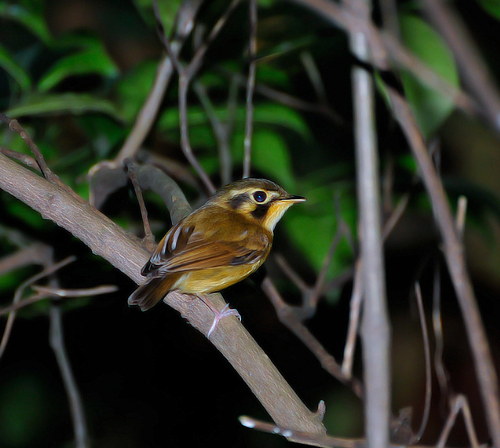
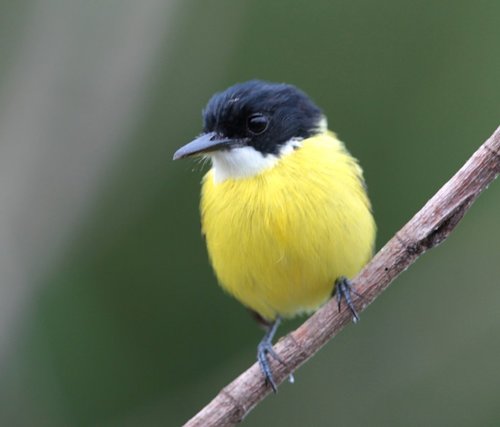
The golden-crowned spadebill, Platyrinchus coronatus, is the smallest member of its genus. Adults measure 8.5 to 9 cm (3.3 to 3.5 in) in length and weigh 8 to 9 g (0.28 to 0.32 oz). It has a large head with a distinct bold facial pattern and a short stubby tail. Males and females have nearly identical plumage, differing only in the color of their crown patch. Males of the nominate subspecies have a black crown with a partially hidden central patch of orange-rufous, while females have a purer orange central crown patch. Both sexes of all subspecies have pale buff-yellow markings that form a patch above the lores, an eye-ring, a stripe behind the eye, and a patch on the ear coverts. Their lores are blackish brown, and this dark color extends as a stripe through and beneath the eye, continuing around the ear coverts. The rest of the head, upperparts, wings, and tail are olive. The throat is pale whitish yellow, and most of the underparts are pale yellow. The breast has an olive wash or olive streaks. Juveniles lack the colorful crown patch, have paler facial markings and paler underparts than adults, with grayish olive upperparts and ochraceous edges on the wing coverts and flight feathers. The subspecies differ slightly in underpart color: P. c. superciliaris has brighter yellow underparts than the nominate subspecies, and P. c. gumia has a brighter yellow belly than the nominate. All subspecies share the same physical characteristics: a dark iris, a wide flat bill with a black upper mandible (maxilla) and pale yellow lower mandible, and pale pinkish legs and feet. The golden-crowned spadebill has a disjunct distribution, with the Andes mountain range separating one subspecies from the other two. Subspecies P. c. superciliaris ranges from northern and eastern Honduras south along the Caribbean slope through Nicaragua, continues through Costa Rica and Panama on both the Caribbean and Pacific slopes, and extends west of the Andes through Colombia, south into northwestern Ecuador as far as northern Los Ríos Province. In Colombia, this subspecies' range also reaches east to Santander Department. Its elevation range is from sea level to 1,250 m (4,100 ft) across Central America, though it only reaches 600 m (2,000 ft) on the Caribbean side of Costa Rica, up to 1,000 m (3,300 ft) in western Colombia, and between 600 and 2,000 m (2,000 and 6,600 ft) in western Ecuador. The nominate subspecies occurs in the Amazon Basin. It is found from southern Amazonas state in southern Venezuela, traveling southwest across southeastern Colombia, and south through eastern Ecuador and eastern Peru into northern Bolivia as far as La Paz Department. Its range extends east into Brazil to the upper Negro River, north of the Amazon River; south of the Amazon, it reaches east to the Xingu River and south to Mato Grosso. P. c. gumia is found from central and eastern Bolívar state in southeastern Venezuela, east through the Guianas and northern Brazil to the Atlantic coast in Amapá. Across all subspecies, the maximum elevation reached is 1,500 m (4,900 ft) in Venezuela, 1,000 m (3,300 ft) in eastern Colombia, between 1,000 and 2,000 m (3,300 and 6,600 ft) in eastern Ecuador, and mostly up to 1,000 m (3,300 ft) but locally higher in Brazil. The golden-crowned spadebill inhabits the tropical and lower subtropical zones of lowlands and foothills. It lives in the understory of humid primary forest and mature secondary forest, including both várzea and terra firme forest types.