About Platyrinchus cancrominus P.L.Sclater & Salvin, 1860
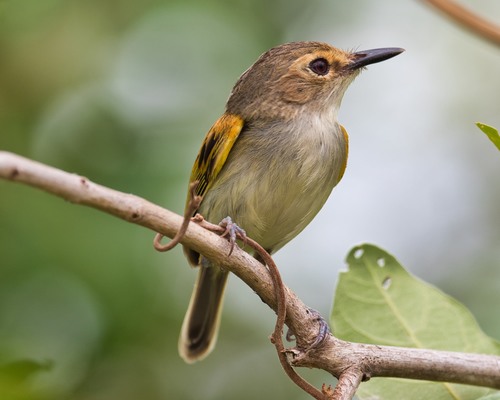
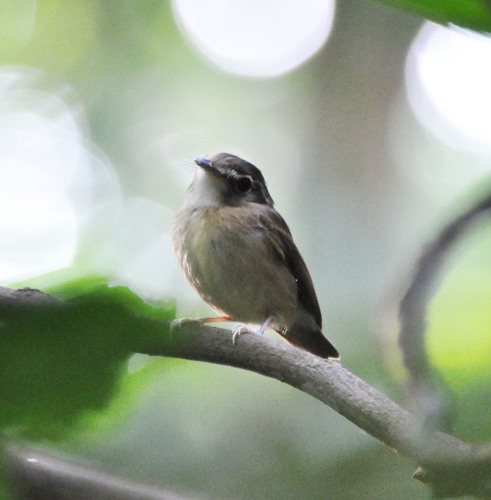
The stub-tailed spadebill (Platyrinchus cancrominus P.L.Sclater & Salvin, 1860) can grow up to 9.5 cm (3.74 in) long and weigh up to 12 g (0.42 oz). It has brown plumage on its head, which extends down to the mantle, and also on its wings. It has a pale-coloured lower mandible, leading to a white throat. The abdomen usually has yellow plumage in males, while females may have a mix of brown and yellow plumage. The species' short brown tail is a distinguishing feature that gives it its common name. Stub-tailed spadebills have a broad, flat bill and pinkish feet. They also have a distinct face pattern marked by prominent yellow postocular stripes. One of the most identifying features of this species is a greatly reduced or completely absent crown. Unlike other members of the genus Platyrinchus, the stub-tailed spadebill does not have a developed crown, which led to its recognition as a separate species. Because of its plumage colouring, the species is often described as 'difficult to spot' in its natural habitat. Combined with its slender body shape, this cryptic colouring allows it to blend in and avoid predators. Stub-tailed spadebills can also be easily recognized by their nasal, rapid, shaky "ki-di-di-di-rrril" calls, which they often make after taking short flights. The stub-tailed spadebill's diet consists mainly of arthropods, such as homopteran bugs, ants, beetles, and spiders. It also eats fruits, seeds, and other insects; some individuals may feed exclusively on plants, and can shift preferences between fruits and seeds based on their availability. Stub-tailed spadebills are most commonly observed in tropical dry forests and subtropical moist forests ranging from southern Mexico to Belize, Guatemala, Honduras, Nicaragua, and Costa Rica, covering approximately 1,090,000 km² of land. The species' range spans a large area of Central America and overlaps with ranges of other related species. It occurs at altitudes between 0 and 1500 m above sea level, and occupies tropical forest undergrowth to access its food sources and gain protection from predators. Though the species was not previously recorded in the region, recent studies have found individuals inhabiting forests in northwestern Panama, showing the species can disperse over a larger area than previously thought. It can also colonize newly regrown islands, demonstrating dispersal over water; these populations are thought to be remnants from a time when the species had an even larger range. The current total population is estimated at 50,000 to 500,000 mature individuals, but a decreasing population trend has been observed. This decline is thought to be caused by deforestation and land fragmentation, which destroy the humid forest habitat the stub-tailed spadebill normally occupies. However, this decline is not rapid enough to meet the thresholds for classification as a vulnerable species, so the IUCN currently does not consider the stub-tailed spadebill a threatened species. The species lives in rainforest foliage alongside shrubs and medium-height canopy trees, in undergrowth that commonly includes plants from the Rubiaceae and Phyllanthaceae families, plus hemiepiphytes and epiphytes. This undergrowth structure lets stub-tailed spadebills perch directly above prey hidden in the foliage. Stub-tailed spadebills may be found alone or in pairs, and forage for food in the undergrowth they inhabit. They feed on small drupes and berries that grow at the lower rainforest levels they occupy. They scavenge dead grass and plant fibers from their undergrowth habitat for nesting. During the breeding season, individuals in Costa Rica have been observed using collected grasses and plant fibres to build deep, cone-shaped cup nests. These nests are usually placed on low saplings near the nesting material collection sites. Stub-tailed spadebills often join mixed-species feeding flocks, where different bird species forage together. This behaviour is thought to reduce predation risk through increased shared vigilance. They mainly forage alongside tanagers, flycatchers, and warblers. This flocking behaviour allows stub-tailed spadebills to successfully maintain foraging in their trophic niche even when competing species are present, as all flock members hunt collectively.