About Platyja umbrina (Doubleday, 1842)
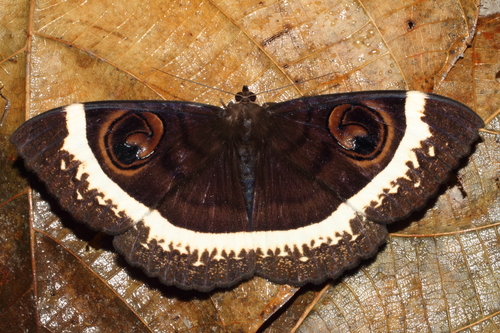
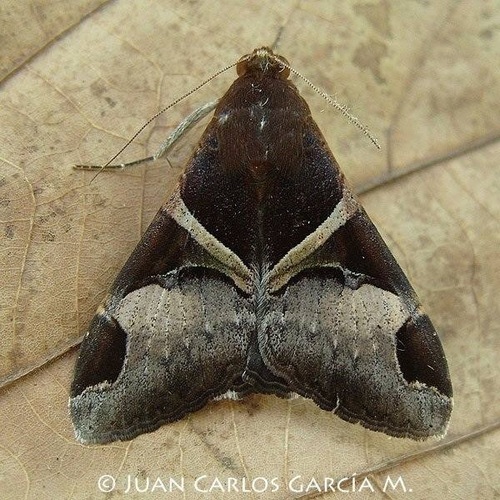
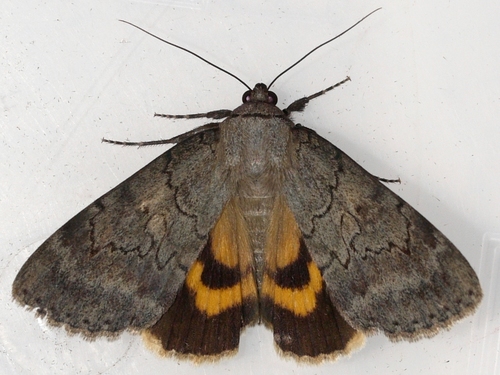
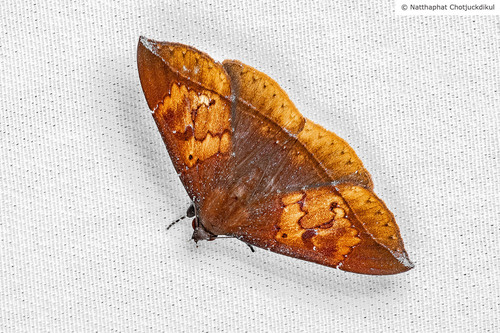
This species of moth, Platyja umbrina, displays strong sexual dimorphism between males and females. Males have highly modified wings, and their abdomen extends well past the hindwings, with a noticeable black tuft at the tip that grows from the valves of the genitalia. The upper surface of male wings is uniformly dark brown, sometimes fading slightly paler toward the margin, and rarely has the blue speckling seen in the typical mainland Asian race. Females have a wing appearance that is more standard for the Platyja genus. On the female forewing, the strongly looped postmedial line is much more clearly defined, and prominent, relatively straight submarginals mark the edge of a paler marginal zone. Females show some variation: some forms are uniformly brown, while others are more patterned with extensive ochreous areas along the margin and between the antemedial and submarginal lines of the forewing. There was historical confusion over the correct identification of female P. umbrina. Based on matching geographic and altitude ranges, as well as similar sexual dimorphism seen in the Sulawesi member of this species group, the original proposal made by Willie Horace Thomas Tams in 1924 and Joseph de Joannis in 1929 is accepted as correct: the taxon P. umbrina rufiscripta actually describes the female of P. umbrina. Platyja umbrina is distributed in northeastern Himalaya, Vietnam, Thailand, Hainan, and Sundaland. It occurs infrequently in lowland forests.