About Platycleis grisea (Fabricius, 1781)
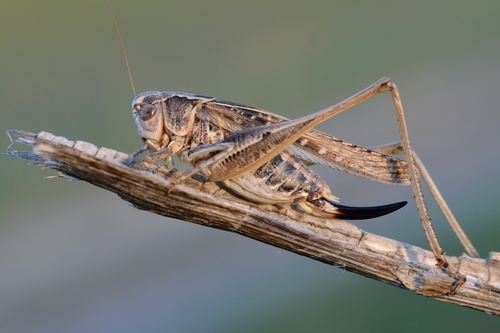
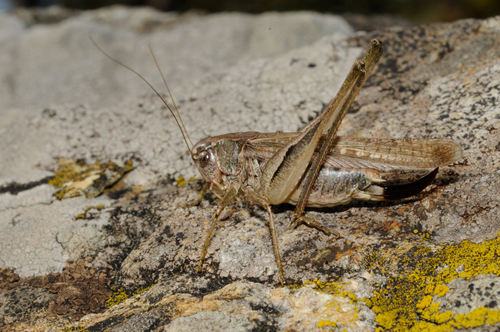
Platycleis grisea (Fabricius, 1781) has a body length between 15 and 24 mm. Individuals are usually quite uniformly coloured from grey to light brown, with darker brown marbling and a lighter coloured underside. Its forewings are typically whitish with dark spots. The side lobes of the pronotum often have a coarser brown pattern, bordered by a narrow pale line, and a distinct central keel is visible on the front half of the pronotum. The upper surface of the pronotum is rarely green or ivory-coloured, and is often reddish. Like all species in the genus Platycleis, this species is almost always long-winged: when at rest, its wings clearly extend past the tip of the abdomen and also past the rear knees. The species is a strong flier, and its populations can disperse easily. In females, the dark-coloured ovipositor is relatively short and curves evenly upwards. In males, the inner surface of the cerci is serrated beyond the distal half. This species is very similar to Platycleis albopunctata, which is nearly identical in body shape and colouration. Hybrids between the two species may occur in the southern Alps, and the two can only be definitively distinguished by examining their genitalia. Their calling songs are also very similar: the song consists of soft four- to six-syllable chirps that continue for several minutes, and can only be heard from within a few metres. Like its similar congener, P. grisea prefers warm, dry grasslands and other open habitats with often patchy vegetation. It also occurs in semi-urban habitats including railway embankments, road embankments, and quarries. Sexually mature adult individuals can be found from June to October.