About Platycladus orientalis (L.) Franco
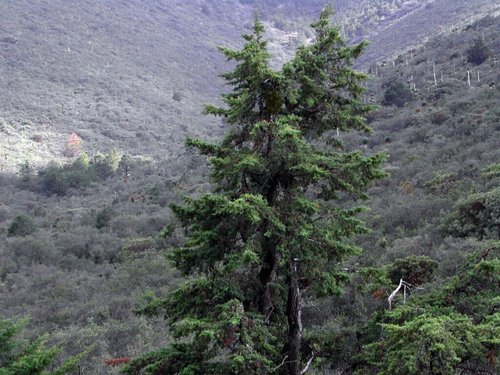
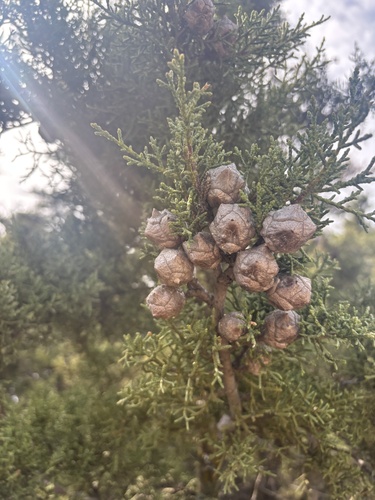
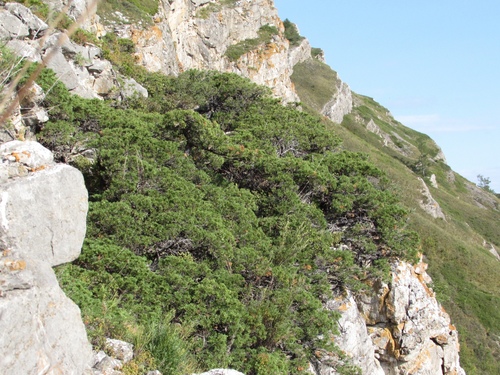
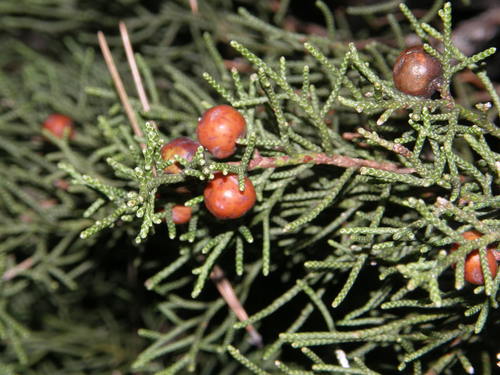
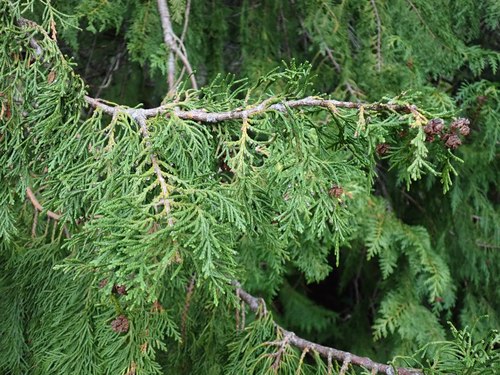
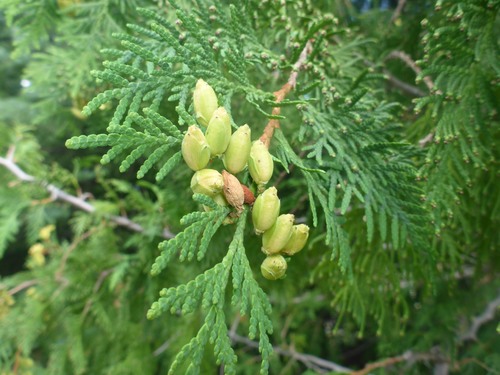
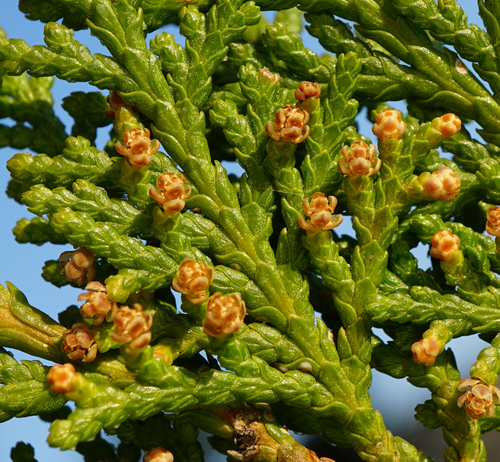
Platycladus orientalis (L.) Franco is a small, slow-growing monoecious tree. It typically reaches 15–20 m (49–66 ft) in height with a trunk diameter of 0.5 m (1 ft 8 in); very old exceptional specimens can grow to 30 m (98 ft) tall and 2 m (6 ft 7 in) in diameter. Its foliage grows in flat sprays, made up of bright green scale-like leaves 2–4 mm (0.08–0.16 in) long, which may turn brownish or coppery orange during winter. Cones are 1.5–2.5 cm (5⁄8–1 in) long, starting green and ripening to brown approximately eight months after pollination. They have 6–12 thick scales arranged in opposite pairs. Seeds measure 4–6 mm (0.16–0.24 in) long and have no wing.
Its branches are relatively short, loosely arranged, and usually grow sharply upward. The brownish bark peels away in narrow vertical strips. Twigs are compressed and arranged in vertical planes. Leaves grow in four rows; they are fleshy, opposite, decussate, truncated, and become imbricated when mature. They curve somewhat inward, have a uniform green color, and bear a resiniferous gland on the underside. Immature female cones are pink-salmon, then turn bluish-greenish; they reach around 1 cm in size, mature annually, and are oval, with 6-8 flattened, thick, coriaceous scales each bearing an apical hook.
This species is native to northwestern China, but it is not possible to reliably distinguish its native range from areas where it has been introduced. It occurs in Manchuria and the Russian Far East (Amur and Khabarovsk), and is now also naturalised in Korea, Japan, India, Florida and Iran. It is widely cultivated across much of the world in parks, gardens, home yards, cemeteries, and grown to form hedges.
It is drought-resistant and very commonly used as an ornamental tree, both in its native range, where it is linked to long life and vitality, and widely in other temperate regions. It responds well to pruning and forms year-round opaque hedges, but can also grow into an impressive slender solitary specimen. Several cultivars have been selected for cultivation, and the cultivar 'Aurea Nana' has received the Royal Horticultural Society's Award of Garden Merit. In Buddhist temples, its wood is used for construction and chipped for use as incense. Its twigs and leaves contain 0.12% essential oil, which includes pinene and likely caryophyllene. Its use as a memorial tree in China dates back to the Zhou dynasty, when it was the official memorial tree for princes.