About Platismatia glauca (L.) W.L.Culb. & C.F.Culb.
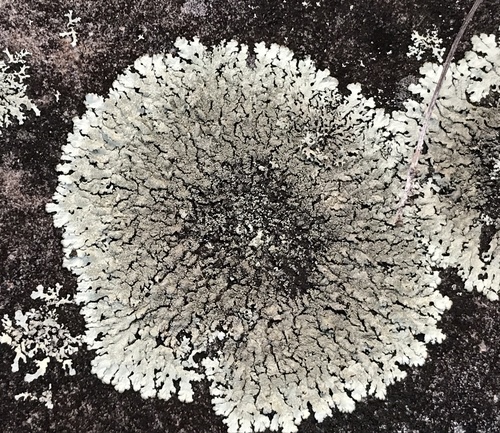
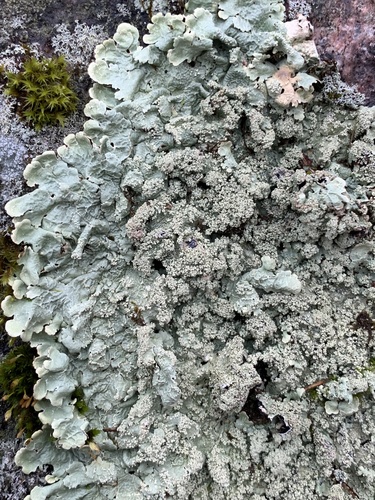
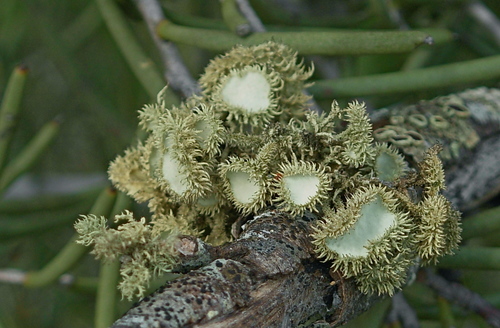
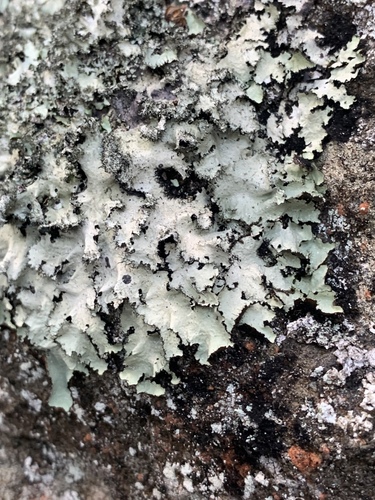
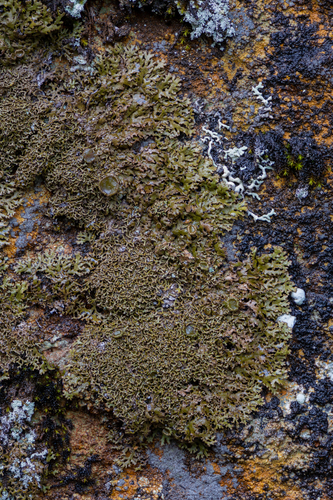
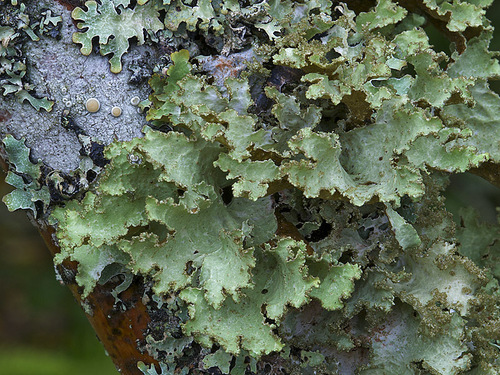
Platismatia glauca is a foliose lichen species that typically forms extensive patches 1–6 cm in diameter, though occasional specimens can grow up to 15 cm across. The thallus, the main body of the lichen, is relatively thin, with lobes reaching up to 1.5 cm in width. These lobes have a characteristic wavy, irregularly indented appearance with ascending margins that may be entire, meaning smooth-edged, or sub-lobulate, meaning slightly lobed. The margins often have distinctive clusters of reproductive structures, which can be simple to coralloid, coral-like, much-branched isidia (small vegetative propagules), or partially granular soredia (powdery propagative structures). The upper surface of the lichen is usually pale to dull grey, and often has a brownish tinge; it becomes entirely brown in areas exposed to high light levels. This colour does not change when the lichen is wet. The surface texture ranges from smooth to wrinkled or slightly ridged, and lacks pseudocyphellae, which are small pores in the upper cortex. The lower surface is mostly black, but may appear brown or white in shaded conditions, especially near the margins. This underside has a variable number of scattered rhizines, which are root-like structures that attach the lichen to its substrate, and the rhizines may be unbranched or branched. Fruiting bodies called apothecia are extremely rare in this species. When present, they measure 5–9 mm in diameter, and typically grow along the margins. These apothecia have a reddish-brown disc with a thin thalline margin that becomes less distinct as the apothecium matures. The ascospores, which are sexual spores, measure 3.5–8.5 by 3–5 μm. Chemical spot testing shows the cortex tests K+ (yellow) because it contains atranorin. The medulla, the inner layer of the lichen, tests C−, K−, KC−, Pd−, and does not fluoresce under ultraviolet light (UV−). The main chemical substance found in the medulla is caperatic acid.