About Platanus occidentalis L.
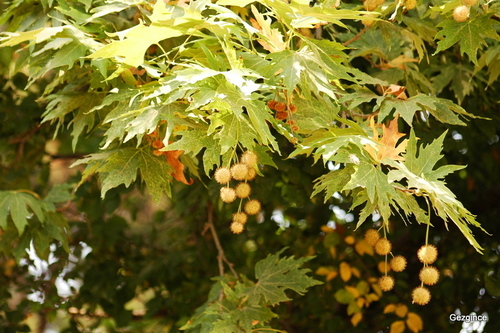
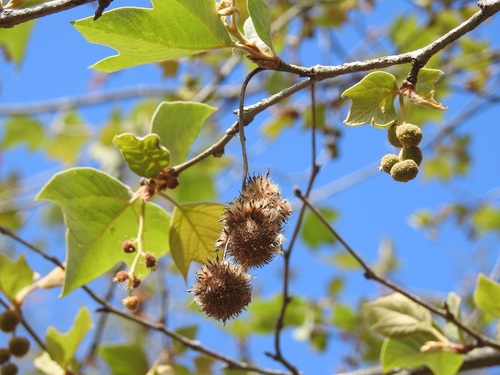
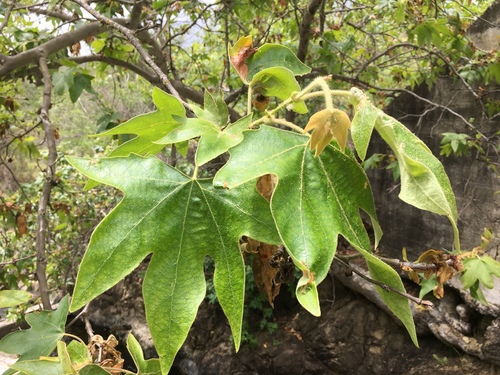
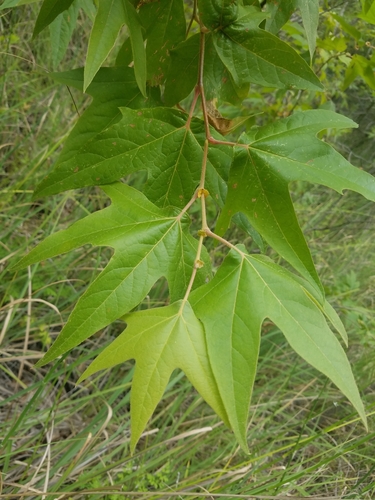
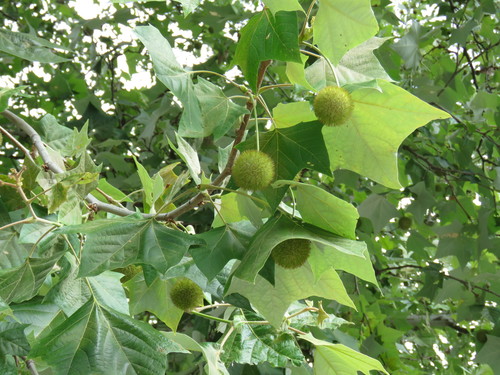
Platanus occidentalis L., commonly called American sycamore, can often be easily distinguished from other trees by its mottled bark that flakes off in large irregular masses, leaving the surface mottled with gray, greenish-white, and brown. All tree bark must accommodate a growing trunk through stretching, splitting, or infilling, but sycamore bark is more rigid and less elastic than the bark of other trees. To accommodate the growth of the wood underneath, the tree sheds its bark in large, brittle pieces. A sycamore can grow to massive proportions. When grown in deep soils, it typically reaches 30 to 40 m (98 to 131 ft) high and 1.5 to 2 m (4.9 to 6.6 ft) in diameter. The largest recorded specimens of the species have measured 53 m (174 ft) in height, and nearly 4 m (13 ft) in diameter. Even larger specimens were recorded in historical times: in 1744, a Shenandoah Valley settler named Joseph Hampton and his two sons lived for most of the year inside a hollow sycamore in what is now Clarke County, Virginia. In 1770, at Point Pleasant, Virginia (now in West Virginia) near the junction of the Kanawha and Ohio Rivers, George Washington recorded in his journal a sycamore measuring 13.67 m (44 ft 10 in) in circumference at 91 cm (3 ft) from the ground. Sycamore trees are often divided near the ground into several secondary trunks that have very few lower branches. Spreading limbs at the top form an irregular, open crown. The species has fibrous roots, and the trunks of large trees are often hollow. A unique characteristic of this species involves how new buds are formed. By early August, most other tree species have tiny buds nestled in the axils of their leaves that will produce the following year’s leaves. Sycamore branches do not have such axil-positioned buds. Instead, the petiole develops an enlargement that encloses the developing bud in a tight-fitting case at the base of the petiole. Mature lower bark is dark reddish brown, broken into oblong plate-like scales. Higher on the tree, bark is smooth and light gray, and separates freely into thin peeling plates that leave the exposed surface pale yellow, white, or greenish. Young branchlets are first pale green, coated in thick pale fuzz, later become dark green and smooth, and finally light gray or light reddish brown. Its wood is light brown with a red tinge; it is heavy, weak, and difficult to split. It is largely used for furniture, interior house finishing, and butcher’s blocks. The wood has a specific gravity of 0.5678, and a relative density of 0.53724 g/cm³ (33.539 lb/cu ft). Winter buds are large, odorous, sticky, green, and covered in three scales. They form in summer, enclosed within the petiole of a full-grown leaf. The inner scales enlarge as the bud develops, and the species does not produce a terminal bud. Leaves are alternate, palmately nerved, broadly ovate or orbicular, 10 to 23 cm (4 to 9 in) long, with a truncate, cordate, or wedge-shaped base that is decurrent on the petiole. Leaves are three to five-lobed, with broad shallow sinuses that are rounded at the bottom; lobes are acuminate, and may be toothed, entire, or undulate. When leaves emerge from the bud, they are folded, pale green, and coated in pale fuzz. When fully grown, they are bright yellow-green above and paler beneath. In autumn, they turn brown and wither before falling. Petioles are long, abruptly enlarged at the base, and enclose the developing buds. Stipules with spreading, toothed borders are conspicuous on young shoots, and fall off early. Flowers bloom in May alongside new leaves; they are monoecious, and produced in dense heads. Staminate and pistillate heads grow on separate stalks: staminate heads are dark red, on axillary stalks, while pistillate heads are light green tinged with red, on longer terminal stalks. Staminate flowers have three to six tiny scale-like sepals that are slightly joined at the base and half as long as the pointed petals. Pistillate flowers have three to six, usually four, rounded sepals, much shorter than the acute petals. The corolla has three to six thin scale-like petals. In staminate flowers, stamens match the number of calyx divisions and sit opposite them; filaments are short, anthers are elongated and two-celled, cells open through lateral slits, and connectives are hairy. For pistillate flowers, the ovary is superior, one-celled, sessile, ovate-oblong, surrounded at the base by long jointed pale hairs; styles are long, incurved, red, and stigmatic, with one or two ovules. Fruits are brown heads that are solitary, or rarely clustered, 2.5 cm (1 in) in diameter. They hang on slender stems 7.6 to 15.2 cm (3 to 6 inches) long, and persist through the winter. These heads are made up of achenes around 1.7 cm (two-thirds of an inch) in length, and mature in October. In its native range, it is most often found in riparian and wetland areas. Its native range extends from Iowa to Ontario and New Hampshire in the north, west to Nebraska, and south to Texas and Florida. It is confirmed to be extirpated from Maine, and can still be found in southeastern Minnesota. Closely related species in the Platanus genus occur in Mexico and the southwestern United States. It is sometimes grown for timber, and has become naturalized in some areas outside its native range. It grows successfully in Bismarck, North Dakota, and is sold as far south as Okeechobee, Florida. It is well adapted to Argentina and Australia, and is widespread across Australia, especially in the cooler southern states of Victoria and New South Wales. American sycamore is found most commonly in bottomland or floodplain areas, thriving in the wet environments provided by rivers, streams, or abundant groundwater, though it will die if flooded for more than two weeks at a time. It is a fast-growing, early-mid successional hardwood tree species. Its life cycle follows the pattern of a "weedy" species: it reaches reproductive maturity relatively young, and produces large numbers of wind-distributed seeds. The dominance of sycamore in a forest depends on local growing conditions; it is often a pioneer species, but in the ideal wet sites it prefers, it persists as a subclimax to climax species, in part because of its fast growth and very long lifespan. As one of the largest trees in the wet bottomland habitats where it often dominates, it is a key component of these habitat’s structure. The heartwood of a sycamore tree decays quickly, producing large hollow cavities in the center of trunks that many animals use as nesting sites. The largest hollow trees are big enough for black bear dens, while average-sized trees provide shelter for bats and cavity-nesting birds including wood ducks, barred owls, screech owls, chimney swifts, and great-crested flycatchers. American sycamore can tolerate harsh city conditions, and was formerly planted extensively as a shade tree. However, due to the damaging defoliation caused by anthracnose, it has largely been replaced in this use by the disease-resistant London plane tree. Its wood has been used extensively for butcher’s blocks, and for boxes and crates. Though the wood is coarse-grained and difficult to work with, it has also been used to make furniture, siding, and musical instruments. Investigations have been done into its potential use as a biomass crop. Historically, Native Americans used the tree’s bark to make small dishes for gathering whortleberries.