About Platanthera yadonii (Rand.Morgan & Ackerman) R.M.Bateman
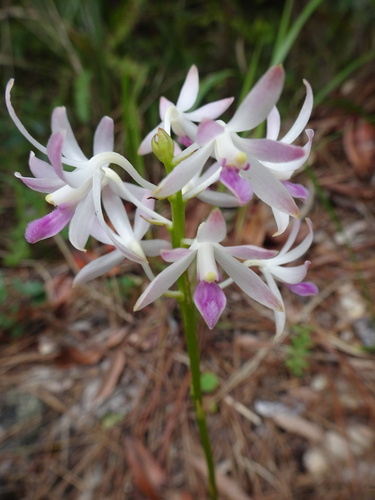
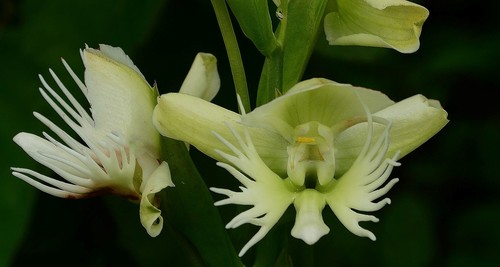
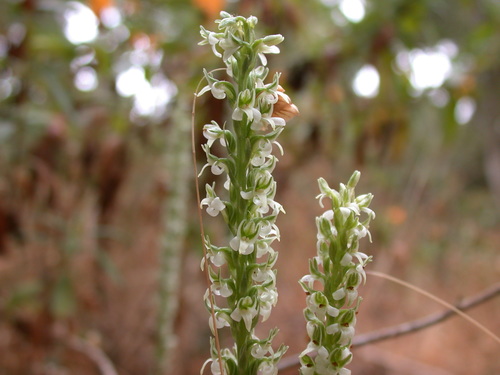
Like most other orchids, Platanthera yadonii, commonly called Yadon's piperia, is a bisexual perennial green plant that grows from buried tubers, and produces a fruit capsule holding numerous tiny seeds. Its pollen is sticky and removed as sessile anther sacs, and its stigma is fused with its style into a column. This species forms a basal rosette of leaves. As a terrestrial wild orchid, it has a subsurface rhizome structure that produces tubers; the rhizome obtains nutrients from fungal intermediates and may also store some of these nutrients. The basal leaf rosette develops from a tuber at the soil surface, and plants produce two or three lanceolate leaves. Each leaf measures 10 to 15 centimeters long and 20 to 35 millimeters wide, and leaves of younger plants are usually smaller in size. A dense inflorescence grows on a single erect spike that ranges from 12 to 55 centimeters in height. Each flower has a spur 1.5 to 5 millimeters long, which is shorter than spurs found on other members of the genus. Typically, Yadon's piperia has three upper tepals that carry both green and white pigment, and three lower tepals that are only white. Blooming can occur as early as June, and as late as August; when blooming late, all of the plant's sepals and petals may be purely white. A key identifying feature is its characteristically short spur, which typically measures 1.5 to 6.0 millimeters in length. The leaves of P. yadonii usually wither by blooming time, except in a small percentage of very large individuals. The geographic range of P. yadonii overlaps with that of P. elegans, P. elongata, P. michaelii, and P. transversa, so P. yadonii can only be clearly distinguished from these related species when it is in flower. Sympatric mixed populations of P. yadonii with P. elongata and P. elegans have been recorded in scientific literature. Yadon's piperia is restricted to a small number of locations in coastal north Monterey County, California, primarily the Del Monte Forest on the Monterey Peninsula. Tiny populations have also been found in the Prunedale Hills, and an isolated southernmost population occurs on Rocky Creek Ridge (Cushing Mountain) at Big Sur. Documented specific locations within these areas include the S.F.B. Morse Botanical Reserve, Manzanita County Park, and The Nature Conservancy’s Blohm Ranch Nature Preserve. Each colony has a small patch size, on the order of 20 acres or less. All known populations occur below approximately 250 meters above mean sea level, and all sit within six miles of the Pacific Ocean. Yadon's piperia is generally restricted to three habitat types. Over 80 percent of known populations grow in Monterey pine (Pinus radiata) forest, sometimes alongside Gowen's cypress (Cupressus goveniana ssp. goveniana). The second habitat is California Northern coastal scrub, with dwarfed Hooker's manzanita (Arctostaphylos hookeri ssp. hookeri) or Eastwood's manzanita (Arctostaphylos glandulosa). The third habitat is Monterey cypress (Cupressus macrocarpa) forest. Colonies growing in woodland settings occur under partial canopy in an open, primarily herbaceous understory. The Monterey Peninsula and northern Big Sur areas have a pronounced marine climate shaped by cool water upwelling from the Monterey submarine canyon. Annual rainfall in this region measures 40 to 50 centimeters, but summer fog drip provides a critical source of moisture for Yadon's piperia and other plants, which would not be able to persist with this low amount of annual rainfall without the extra fog moisture. Like other orchids, seeds of this species lack an endosperm. The extremely small seeds must come into contact with appropriate soil fungi to germinate. After germination, developing seedlings obtain fixed carbon from their host fungus until they produce their first leaves and begin to photosynthesize, a strategy called myco-heterotrophy. This species can also reproduce vegetatively.