About Platanthera psycodes (L.) Lindl.
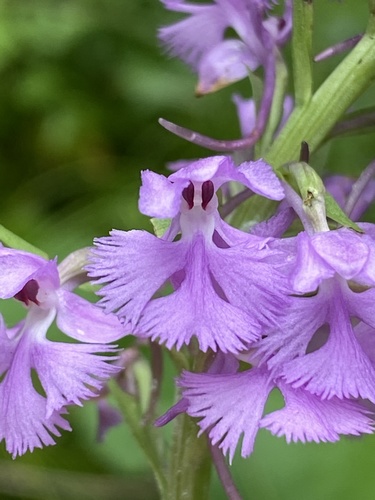
Platanthera psycodes (L.) Lindl., commonly known as the lesser purple fringed orchid or small purple-fringed orchid, is an orchid species belonging to the genus Platanthera. This species occurs across eastern Canada, ranging from Manitoba to Newfoundland, and extends into east-central and northeastern United States, including the Great Lakes Region, the Appalachian Mountains, and New England. It is classified as imperiled in Illinois, Tennessee, North Carolina, and Kentucky. Its specific epithet psycodes is a misspelling of psychodes, a word meaning "butterfly-like", which most likely refers to the shape of the species' flowers. Like many other orchid species, it grows in wet habitats, including sedge meadows, flatwoods, sphagnum bogs, cedar swamps, alder swamps, stream edges, and the moist edges of coniferous forests. It is occasionally found in wet swales that adjoin freshwater sandy beaches. It prefers cooler habitats, and its range is shifting northward as global temperatures warm. According to records from Correll, this orchid occurs at 1,500-foot (460 m) altitudes in Vermont, 4,000-foot (1,200 m) altitudes in Virginia, and 6,500-foot (2,000 m) altitudes in North Carolina and Tennessee. It is often misidentified as its close relative Platanthera grandiflora. The two species can be distinguished by multiple traits: P. grandiflora generally has larger flowers, with a lip (labellum) 10 to 25 millimetres (1⁄3 to 1 in) long, and a circular nectary opening. In contrast, P. psycodes has smaller flowers, with a labellum 5 to 13 millimetres (1⁄4 to 1⁄2 in) long, and an oblong or almost rectangular nectary opening. The most critical trait separating the two species is the shape of the flower's column, and the resulting different placement of pollinia on pollinators. In P. psycodes, the column shape causes pollinia to attach to the pollinator's proboscis. In P. grandiflora, the column is larger, and the pollinia's viscidia are widely spaced and outwardly rotated. This arrangement places the pollinia on the pollinator's eyes. P. grandiflora has a far more restricted range than P. psycodes. Where the two species' ranges overlap, they are separated by blooming time: P. grandiflora typically blooms from late June through early July, while P. psycodes blooms from late July through early August.