About Platanthera chlorantha (Custer) Rchb.
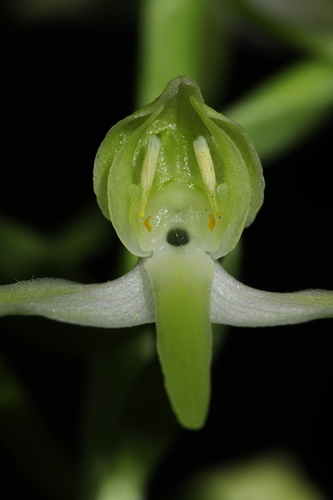
Platanthera chlorantha (Custer) Rchb., commonly called the greater butterfly-orchid, is a species of orchid belonging to the genus Platanthera. The genus name Platanthera comes from Greek and means "broad anthers", while the species epithet chlorantha translates to "green-flowered". Greater butterfly-orchid is a medium-sized herbaceous perennial plant. It is similar in size to the closely related lesser butterfly-orchid, Platanthera bifolia, but differs by having larger flowers. This species produces a large pair of broad, shiny, elliptical leaves at the base of the plant, with much smaller, more lanceolate leaves growing further up the stem. Its greenish-white flowers are vanilla-scented, with spreading sepals and petals. The flower lip is long, narrow, and undivided, and the flower has a very long spur. Flowers are arranged in a rather loose spike. The pollen masses of the flower diverge to touch both sides of the pollinating insect. In Britain, this orchid flowers from June to July; flowering occurs earlier in southern Europe. It grows in woods, open scrub, and grassland, including chalk grassland. Its global range is largely restricted to Europe: it extends from the British Isles in the west to European Russia and the Caucasus in the east, and from the coastal region of Norway up to 65°N, south through all of Italy and the Balkans, excluding most of Greece. Scattered outlying populations occur in Spain, Turkey, and North Africa, including Morocco.