About Platanthera blephariglottis (Willd.) Lindl.
Platanthera blephariglottis (Willd.) Lindl. flowers from late spring to summer. This plant grows 8 to 110 centimeters (3 to 43 inches) tall, and can be found in bogs and on moist banks of lakes and rivers in eastern North America.
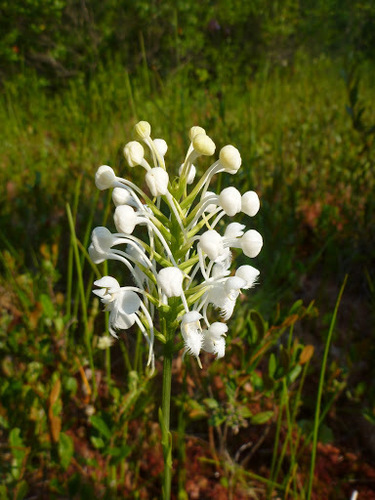
At least 2, and often several, spreading to ascending leaves are scattered along the stem. Leaves have one of three lanceolate shapes: linear-lanceolate, ovate-lanceolate, or elliptic-lanceolate. The plant produces dense to lax spikes of showy white flowers. Its lateral sepals bend downward and outward at an angle greater than 90 degrees. The petals are linear, narrow toward their point of attachment, and are nearly entire with fringed edges.
The species is often found growing in sphagnum and other acidic moss, in open wet areas of black spruce and/or tamarack bogs, on boggy lake shores, and in open wet meadows. It is native to the Nearctic realm. Its native distribution includes Eastern Canada: Ontario, Quebec; Northeastern United States: Connecticut, Maine, Massachusetts, Michigan, New Hampshire, New Jersey, New York, Ohio, Pennsylvania, Rhode Island, Vermont; North-Central United States: Illinois, Missouri, Wisconsin; Southeastern United States: Alabama, Delaware, Florida, Georgia, Louisiana, Maryland, North Carolina, South Carolina, Virginia; South-Central United States: Texas. Sources: NRCS, WSH.
Additionally, P. blephariglottis forms many hybrid zones along the eastern coast of the United States, with Platanthera ciliaris as the common counterpart species for most of these hybrid zones.