About Plantago triandra Berggr.
Growth Form
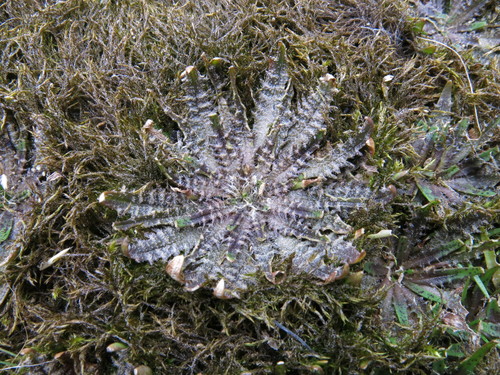
Plantago triandra Berggr. grows as small rosettes, with a primary root up to 12 mm thick.
Leaf Count and Axillary Hairs
Each rosette can produce up to 62 generally angular-ovate leaves, with visible short rust-colored leaf axillary hairs shorter than 13 mm in the basal rosette.
Leaf Vein and Dimensions
Each leaf has a single vein, measuring 8–61 mm long including the petiole and up to 11 mm wide.
Leaf Surface Texture
Leaves are sometimes punctate, glabrous on both surfaces, or have hair bands to sparsely hairy on the upper surface.
Leaf Apex and Margins
Leaf apices are acute, and leaf margins are smooth, wavy, or bear up to 24 small to large teeth.
Petiole Characteristics
The petiole is usually distinguishable from the leaf blade, and grows up to 23 mm long.
Inflorescence Count and Size
Each rosette can have up to 22 erect inflorescences, which reach up to 41 mm in length.
Scape Characteristics
Scapes are smooth, and can be either glabrous or hairy.
Spike and Flower Count
Spikes are globose, holding 1–3 densely crowded flowers.
Floral Bract Traits
Each flower has a small broadly ovate to very broadly ovate bract that is usually glabrous.
Calyx Characteristics
The calyx measures 0.3–1.7 mm long and 0.3–1.1 mm wide, and is mostly glabrous, only rarely bearing a hair at its apex.
Corolla, Stamen and Style Dimensions
The corolla tube is 2.0–4.4 mm long, corolla lobes are 0.9–2.9 mm long, stamen filaments 1.7–6.8 mm long, anthers 0.7–1.4 mm long, and the style is 2.7–10.0 mm long and densely hairy.
Ovary Traits
The ovary is 0.7–2.6 mm long, and contains up to 42 ovules.
Capsule Characteristics
The fruit is a dry, dehiscent capsule with circumscissile dehiscence, shaped ellipsoid or globose, widest at the middle, 2.1–4.3 mm long and 1.5–3.9 mm wide.
Seed Traits
Each capsule holds 8–42 uniform rust or brown seeds 0.5–1.4 mm long, which are usually rhomboid or angular-ovoid.
Flowering and Fruiting Periods
Plantago triandra flowers from December to May and fruits from December to June.
Chromosome Number
Its chromosome number is 2n=48.
Endemic Range
This plantain is endemic to the North, South, Stewart and Chatham Islands of New Zealand.
Regional Distribution within New Zealand
In the North Island, it occurs in the Auckland, Volcanic Plateau, Taranaki, and Southern North Island regions; on the South Island, it occurs in the Marlborough, Western Nelson, Westland, Canterbury, Otago, Fiordland, and Southland regions.
Natural Habitat and Elevation Range
It grows in coastal banks, cliffs, herbfields, dunes and rock outcrops in damp or wet areas, from sea level up to 1,520 m (4,990 ft) above sea level.
Anthropogenic Habitat
It may also grow on bowling or golf course greens.