About Plantago lanceolata L.
Taxon Identity
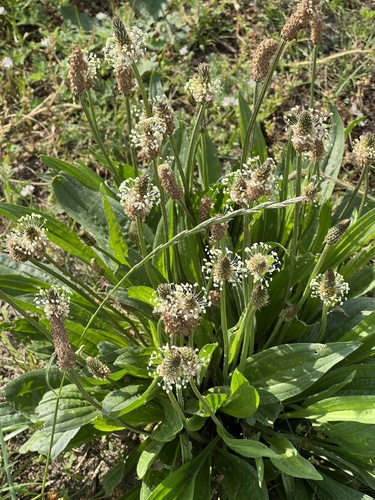
Plantago lanceolata L. is a rosette-forming perennial herb, with leafless, silky, hairy flower stems.
Height
It typically grows to 45 centimetres (17+1⁄2 in) tall, and may reach an exceptional maximum height of 100 cm (39 in).
Basal Leaf Morphology
Its basal leaves are lanceolate, either spreading or erect, with very few teeth, 3–5 strong parallel veins, and narrow into a short petiole.
Flower Stalk Structure
Its flower stalk is deeply furrowed, ending in an ovoid inflorescence that holds many small flowers, each accompanied by a pointed bract.
Seed Production
A single inflorescence can produce up to 200 seeds.
Individual Flower Morphology
Individual flowers are 4 millimetres (1⁄8 in) across, with a green calyx and brownish corolla, four bent-back lobes marked with brown midribs, and long white stamens.
Native Range
This species is native to Europe and western Asia, where it is common across its native range, including in Britain.
British Isles Soil Preference
It is widespread throughout the British Isles, but only grows sparingly on the most acidic soils with a pH below 4.5.
Introduced Range
It has been introduced to other regions worldwide: it was brought to North America, Oceania and Japan at least 200 years ago, and to South Africa and Chile 150 years ago.
Archaeological Indicator Use
P. lanceolata is considered an agricultural indicator in pollen diagrams, and its presence in western Norway dating to the Early Neolithic is interpreted as an indicator of grazing in that area at the time.
Habitat Range
This species can grow in habitats ranging from very dry meadows to environments similar to rain forest, but it grows best in open, disturbed areas.
Growth Habit Plasticity
For this reason, it is common near roadsides where other plants cannot thrive; it grows tall when conditions allow, but develops a flat growth habit in areas that are frequently mown.
Grazing Habitat Association
Historically, this plant has grown well in areas where ungulates graze and turn over soil with their hooves.
Reproductive Strategy Variation
Reproductive strategy can vary between populations of this species.
Pollination Method
It reproduces sexually: most of its pollen is dispersed by wind, though the plant is occasionally pollinated by bees.
Herbivory by Vertebrates
Songbirds feed on its seeds, and rabbits eat its leaves.
Anti-Herbivore Compounds
Iridoid glycosides produced by the plant make it inedible to some herbivores, but other herbivores are not affected by these compounds.
Butterfly Host Use
A notable example is the buckeye butterfly Junonia coenia: its larvae feed on P. lanceolata leaves and ingest the plant's iridoid glycosides, which makes the larvae unpalatable to their predators.
General Herbal Use
P. lanceolata is frequently used in herbal teas and other herbal remedies.
Cough Medicine Use
A tea made from its leaves is used as a cough medicine.
Austrian Traditional Medicine Use
In traditional Austrian medicine, the leaves are used internally (as syrup or tea) or externally (applied as fresh leaves) to treat disorders of the respiratory tract, skin conditions, insect bites, and infections.
Edible Young Leaves
Very young leaves of this plant are edible.
Flower Bud Culinary Use
Its flower buds have a mushroom-like flavour and can be used to make stock.